“Marriage Deserts”: The New Map Showing Where Family Life Is Disappearing in America
An Institute for Family Studies report released October 8, 2026, using 2020 Census data, maps America's "marriage deserts" and "marriage gardens" — areas where only 13% to 17% of householders are married, and others where 74% to 79% are. Ricardo Martins reflects on the soil your marriage is planted in.
 By Ricardo Martins
Published October 14, 2026 · 6 min read
The news
On October 8, the Institute for Family Studies (IFS) released Marriage Deserts: Mapping America’s Family Divide, a report by Chris Bullivant and Ken Burchfiel that was picked up by the Deseret News and other outlets this week. Using 2020 Census data, the authors divided the country into areas of 100,000 to 200,000 people and measured two things: the share of householders ages 15–64 who are married, and the share of households with children headed by a married couple.
The result is a map of extremes. In the largest “marriage deserts,” only 13% to 17% of householders are married. In the largest “marriage gardens,” it’s 74% to 79% — a gap of more than 60 points. Among households with children, the gap is even wider: in the lowest-ranking areas, only 18% to 26% are headed by married parents; in the highest, roughly 86% to 89%. Deserts cluster in the urban cores of big metro areas; gardens in the suburbs — sometimes just a few miles apart.
An honest caveat: this is a descriptive snapshot. The report shows where marriage is common or rare, not why, and it doesn’t measure whether those marriages are happy. IFS openly advocates for marriage, and the data come from 2020, an unusual pandemic year. It’s a photograph, not a verdict on anyone. But it’s a photograph worth looking at slowly.
A marriage is a plant, not a rock
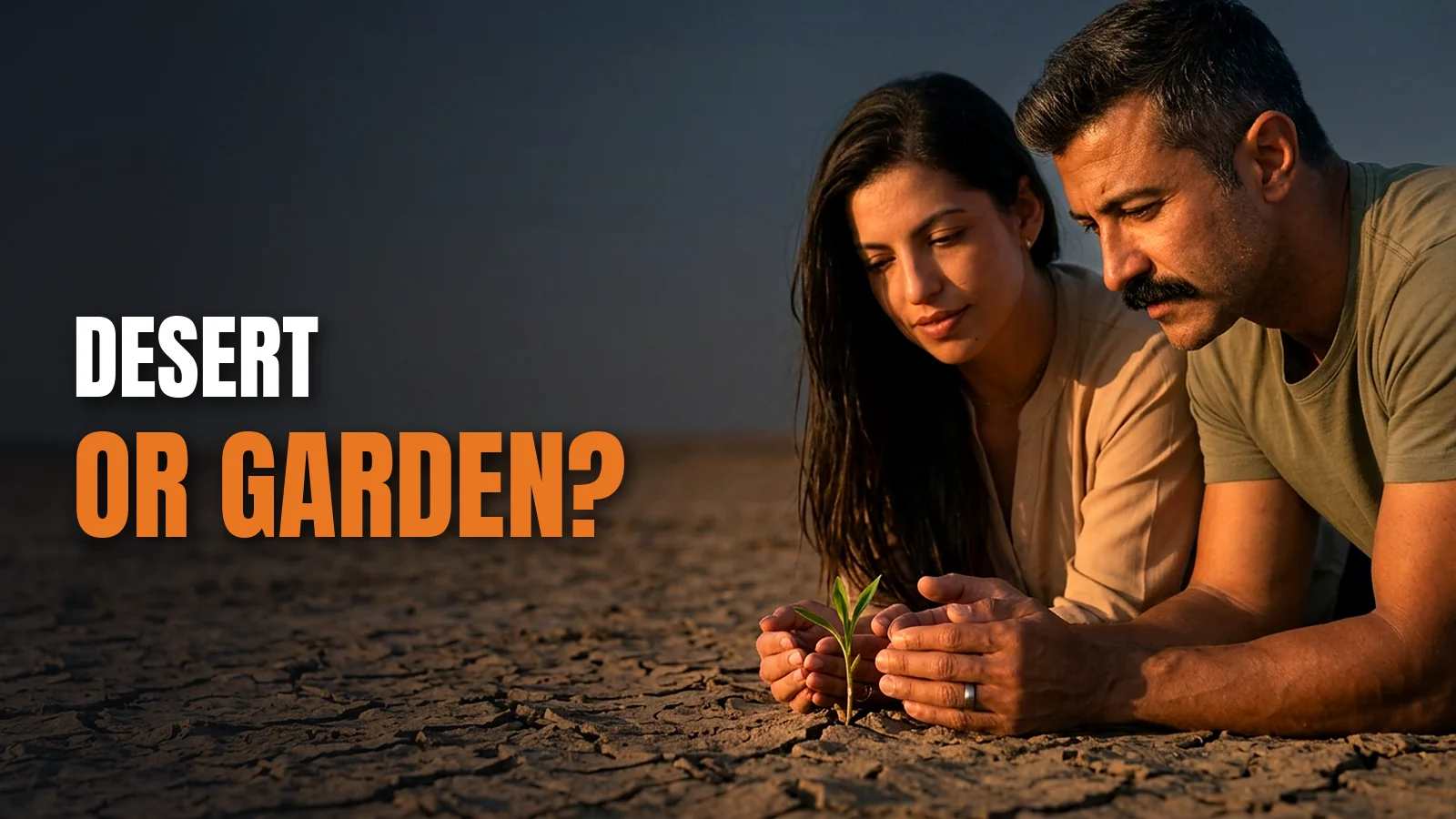
I love the image the researchers chose: desert and garden. Because it names something we forget too easily — marriage is a living thing. And living things depend on their environment.
Nobody plants a seedling in the middle of a parking lot and acts surprised when it dries up. Yet we do that with marriages all the time. A couple marries, moves far from family, has no married friends nearby, belongs to no community, works long hours, spends the rest of the day on their phones — and a few years later can’t figure out why the relationship feels parched.
The report’s own authors say their maps can help newlyweds find areas with more married couples and, therefore, potentially stronger communities and support networks. Notice: that’s not a sermon, it’s the conclusion of people who looked at the numbers. Couples surrounded by other couples have someone to learn from, someone to be honest with, someone to call when things fall apart.
Scripture said it long before the Census:
“Though one may be overpowered, two can defend themselves. A cord of three strands is not quickly broken.” (Ecclesiastes 4:12, NIV)
Two are stronger than one. But the cord that holds has three strands. I believe the third is God at the center of the marriage. And I believe God almost always works through people — the church, friends, older couples who have walked through exactly what you’re walking through.
The desert isn’t just a place on a map
You can live in a “garden” on the map and be in a desert at home. And you can live in a “desert” and have a marriage that’s green.
The desert that destroys the most marriages isn’t geographic; it’s isolation. It’s the couple nobody really knows. It’s the husband who doesn’t have a single male friend he can be honest with. It’s the wife who smiles at church and cries in the car. I was once the problem in my own marriage, and one thing I learned is that sin loves darkness and isolation. Nobody sinks all at once; we drift away from everyone, one step at a time, until we’re alone with our excuses.
That’s why the writer of Hebrews doesn’t treat fellowship as optional:
“And let us consider how we may spur one another on toward love and good deeds, not giving up meeting together, as some are in the habit of doing, but encouraging one another—and all the more as you see the Day approaching.” (Hebrews 10:24–25, NIV)
Meeting together isn’t about checking a Sunday box. It’s about putting yourselves where other people can see your marriage, encourage you, correct you, and hold your hand.
Roots that reach the water
And what if you really do live in a desert? Your family is full of divorce, your friends mock marriage, and nobody on your street stays together more than a few years?
Jeremiah describes the person who trusts in the Lord like this:
“They will be like a tree planted by the water that sends out its roots by the stream. It does not fear when heat comes; its leaves are always green. It has no worries in a year of drought and never fails to bear fruit.” (Jeremiah 17:8, NIV)
The tree doesn’t change the climate. It sends its roots to the water. For a couple, that means a few very concrete decisions:
- Choose a faith community and stay. Not the perfect church — it doesn’t exist. A church where you’re known by name.
- Find an older couple. People who went through a crisis and stayed. One dinner a month with them may be worth more than hours of online content.
- Men, find brothers. That’s what I found in Legendários: men who tell each other the truth. An isolated husband is a vulnerable husband.
- Guard your time as a couple. A garden needs steady watering, not one flood a year.
- Ask for help early. A pastor, a counselor, a Christian therapist. Asking for help isn’t failure; it’s proof you want to keep going.
A word to the church
Every Christian community can be a garden in the middle of a desert — a place where a young couple sees up close that it’s possible to go through a crisis, ask forgiveness, rebuild trust brick by brick, and stay together. Many young couples today have never seen a marriage like that from up close. The church can change that simply by opening its doors and its dinner tables.
God specializes in this kind of work:
“See, I am doing a new thing! Now it springs up; do you not perceive it? I am making a way in the wilderness and streams in the wasteland.” (Isaiah 43:19, NIV)
Maybe your marriage feels like cracked ground today. I won’t promise it will be easy or fast. But I’ve seen God bring streams to dry places — almost always starting with a couple who decided to stop fighting alone.
If you’d like more from Vanessa Lima and me on building a marriage with Christ at the center, follow O Casal Legendário on YouTube and Instagram.
Sources
- Bullivant, C. & Burchfiel, K. (2026). Marriage Deserts: Mapping America's Family Divide (report, October 2026) — Institute for Family Studies
- Charting America's Marriage Deserts and Gardens — Institute for Family Studies, Oct 8, 2026
- Do you live in a 'marriage desert' or a 'marriage garden'? — Deseret News, Oct 10, 2026
Ricardo Martins
Ricardo Martins is an author, pastor and spokesperson for the Legendários men's movement. With his wife, Vanessa Lima, he created The Legendary Couple (O Casal Legendário), reaching millions with content on Christian marriage and restoration. Author of "Quando o amor recomeça" (Citadel, 2026).
Want to talk with Ricardo & Vanessa?
Follow the daily videos on YouTube and Instagram — real testimony, practical steps, and hope for marriages that look finished.
Watch on YouTubeKeep reading
Faithful Christian Couples Have the Happiest Marriages in America: What the New Report Proves (and What It Doesn't)
A new Institute for Family Studies report, "The Devout Difference," finds churchgoing couples are happier, divorce less and have more active intimate lives. Ricardo Martins comments on what the data means for anyone fighting for their marriage.
Read article →
Young Men Are Showing Up at Church Again. Who Will Walk With Them?
A Pew Research Center report released October 28, 2026, finds that 41% of U.S. adults ages 18 to 22 attend religious services at least monthly — and, for the first time in Pew's surveys, young men in that group attend more than young women. Ricardo Martins on what this asks of fathers, husbands and churches.
Read article →
U.S. Fertility Rate Hits Another Record Low: What Are Couples Waiting For?
A CDC report released in October 2026 puts the U.S. fertility rate at about 53 births per 1,000 women ages 15–44 in 2025, the lowest on record. Ricardo Martins reflects on fear, waiting for "perfect security," and what this has to do with marriage.
Read article →This content is educational and pastoral. It does not replace therapy, medical, legal or emergency help. If you are in danger, seek help now.