Baby Arrives, Marriage Drops: What Research Says Protects Couples
Studies that followed couples for six and eight years show the first baby often shakes a marriage. They also show what protects it. Ricardo Martins unpacks Doss (2009) and Shapiro, Gottman & Carrère (2000) — and what to do about it.
 By Ricardo Martins
Published October 14, 2026 · 7 min read
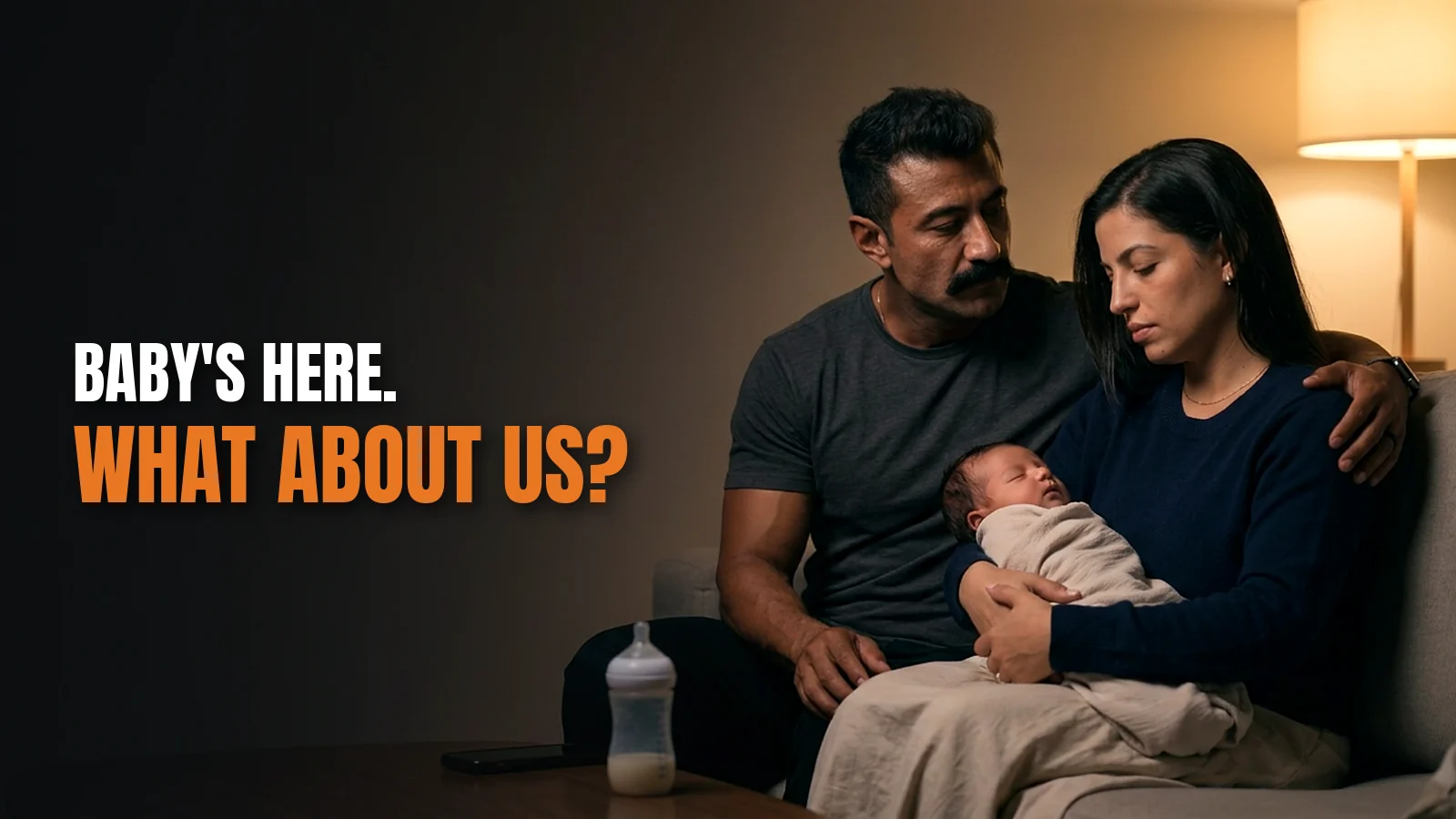
It’s 2 a.m. She’s on the couch nursing, eyes closing on their own. He hears the crying, checks his phone and thinks, “I’ve got an early meeting.” Nobody says a word. But both of them drift back to sleep — or try to — with the same thought: “We love this baby. So where did we go?”
If that’s your season right now, let me start here: you’re not failing. You’re walking through one of the heaviest transitions a marriage can go through. And the good news is that there’s solid research on what knocks couples down in this stage — and what keeps them standing.
Before any numbers, I want to be clear about where I stand: children are a blessing. “Children are a heritage from the LORD, offspring a reward from him” (Psalm 127:3, NIV). Nothing here takes away from that. The baby isn’t the problem. The problem is assuming your marriage will take care of itself while the baby takes up everything.
What an eight-year study found
Brian Doss, Galena Rhoades, Scott Stanley and Howard Markman followed 218 couples (436 people) through the first eight years of marriage. Their findings were published in 2009 in the Journal of Personality and Social Psychology.
Here’s what they saw: compared with how things were before the birth, couples who had their first child showed a sudden decline in their relationship afterward. It showed up both in what spouses reported and in what researchers observed — in the good parts of the relationship and the hard parts. The drop was small to medium in size, and it tended to stick around for the rest of the study.
Two details stood out to me. First, moms and dads changed about the same amount. This isn’t “a mom thing” or “a dad thing.” Both of you feel it. Second, couples who didn’t have kids also slid over the years — but gradually, without that sudden drop. In other words, time wears down any marriage that isn’t tended to. A baby just speeds it up and drags into the light what was already there.
And there’s one line in the study that opens a door of hope: how much couples declined varied from couple to couple, depending on traits of the individuals, the marriage and the pregnancy itself. The dip is common. It’s not the same for everybody. Something protects.
What protected the couples who didn’t fall
That’s where a study by Alyson Shapiro, John Gottman and Sybil Carrère comes in, published in 2000 in the Journal of Family Psychology. They followed 130 newlywed couples for six years. Of those, 43 became parents, and 39 couples without kids served as a comparison group.
Among the wives who became mothers, marital satisfaction declined for 67% and stayed steady or even rose for 33%. Among wives who stayed childless, 49% saw a decline.
So what did that 33% have going for them? The answer came from an interview done in the first few months of marriage — long before any baby. Mothers whose satisfaction held up were the ones whose husbands:
- expressed fondness and admiration for her when talking about their story;
- knew her world well and paid attention to the relationship;
- and whose wives, in turn, knew their husband’s world.
The steeper declines showed up when the husband expressed negativity toward his wife, when he sounded disappointed in the marriage, or when both of them described their lives as chaotic and out of control.
An honest caveat: this is a study of 43 couples, it measures the wife’s satisfaction, and it shows a link, not a guaranteed formula. But the message lands. The friendship you build before the baby is the cushion that softens the fall after.
Guys, this part’s for you
I’m not saying it’s the husband’s fault. I’m saying that in the data, the husband’s posture carried a lot of weight. And Scripture got there first:
“Husbands, in the same way be considerate as you live with your wives, and treat them with respect as the weaker partner and as heirs with you of the gracious gift of life, so that nothing will hinder your prayers.” (1 Peter 3:7, NIV)
“Be considerate” is basically what Gottman called knowing her world — knowing what’s weighing on her, what hurts, what she can’t keep up with. And “treat them with respect” is fondness and admiration said out loud.
Proverbs paints a picture of a husband who does exactly that: “Her children arise and call her blessed; her husband also, and he praises her: ‘Many women do noble things, but you surpass them all’” (Proverbs 31:28–29, NIV). Notice: he praises her. He doesn’t just think it. He says it.
I was once the problem in my own marriage, so I’m not writing this with a finger pointed at anyone. But man to man: don’t wait for your wife to ask for help with the baby before you notice she’s going under.
Three habits for the newborn season
1. Praise her on purpose, every day. Don’t wait until you have free time — you won’t. One specific sentence (“I saw how much you poured out today; you’re an amazing mom”) beats a fancy dinner six months from now. Fondness and admiration aren’t decoration. In the data, they were the biggest buffer.
2. Do a 10-minute check-in every night. Phones down, and no baby talk for the first few minutes. “How was your day, really? What’s weighing on you?” That’s how you keep learning her world — and she keeps learning yours. If 10 minutes is all you’ve got, spend them here.
3. Take the chaos off autopilot. Couples who described their lives as chaotic declined more. You can’t control the baby’s sleep, but you can agree on who takes which night, who owns which chores, and what help you’ll accept from family, friends and your church small group. “Two are better than one, because they have a good return for their labor” (Ecclesiastes 4:9, NIV) — but only if both are working the same plan.
One important note: if her sadness (or yours) is intense, lasts for weeks, or comes with thoughts of not wanting to live, that may be postpartum depression, and it needs a doctor’s evaluation, not just advice. In the U.S., you can call or text 988 (Suicide & Crisis Lifeline) or 911 in an emergency. Getting help is not a lack of faith.
A baby isn’t the end of your marriage
If you’re thinking about having a baby to “fix” a marriage that’s already hurting, read this piece on the “let’s have a baby” myth first. A child isn’t glue. But if you already have a newborn in your arms and feel your marriage slipping, the message is different: the dip is common, not a verdict.
Jesus didn’t say, “Hold it all together on your own.” He said, “Come to me, all you who are weary and burdened, and I will give you rest” (Matthew 11:28, NIV). That’s for the exhausted mom at 2 a.m. and for the dad who doesn’t know where to start. Bring your exhaustion to Him — together.
And remember: “A cord of three strands is not quickly broken” (Ecclesiastes 4:12, NIV). Husband, wife and Christ at the center. Your baby comes into that family as a blessing — not as a replacement for the couple who brought them into the world.
Sources
- Doss, B. D., Rhoades, G. K., Stanley, S. M. & Markman, H. J. (2009). The effect of the transition to parenthood on relationship quality: An 8-year prospective study. Journal of Personality and Social Psychology, 96(3), 601–619 — Journal of Personality and Social Psychology (APA) / PMC
- Shapiro, A. F., Gottman, J. M. & Carrère, S. (2000). The baby and the marriage: Identifying factors that buffer against decline in marital satisfaction after the first baby arrives. Journal of Family Psychology, 14(1), 59–70 — Journal of Family Psychology (APA)
Ricardo Martins
Ricardo Martins is an author, pastor and spokesperson for the Legendários men's movement. With his wife, Vanessa Lima, he created The Legendary Couple (O Casal Legendário), reaching millions with content on Christian marriage and restoration. Author of "Quando o amor recomeça" (Citadel, 2026).
Want to talk with Ricardo & Vanessa?
Follow the daily videos on YouTube and Instagram — real testimony, practical steps, and hope for marriages that look finished.
Watch on YouTubeKeep reading
November Blue: 77,000 Prostate Cancer Cases a Year in Brazil — and the Man Who Cares for Everyone but Himself
As Brazil's "November Blue" men's health campaign began, CNN Brasil reported that the National Cancer Institute (INCA) projects 77,920 new prostate cancer cases a year through 2028, and that shame and fear keep many men from addressing it. Ricardo Martins reflects on the male pride that postpones health — and the couple's role in it.
Read article →
Daily gratitude in marriage: the small habit that shifts the atmosphere at home
The coffee that shows up on the table, the laundry folded, the bills paid — when nobody says thank you anymore, a marriage cools down. Ricardo Martins writes, with 1 Thessalonians 5, Luke 17 and a diary study of couples, about gratitude as a daily habit.
Read article →
Lonely in Marriage: 1 in 4 Married Brazilians Felt Alone, Survey Finds
Brazil's 2026 Mental Health Panorama (Instituto Cactus and AtlasIntel), reported by Folha de S.Paulo, found loneliness to be the factor most linked to poor mental health. Married people felt lonely far less often than singles, yet 26.6% of them still did. Ricardo Martins reflects on loneliness inside marriage.
Read article →This content is educational and pastoral. It does not replace therapy, medical, legal or emergency help. If you are in danger, seek help now.