Lonely in Marriage: 1 in 4 Married Brazilians Felt Alone, Survey Finds
Brazil's 2026 Mental Health Panorama (Instituto Cactus and AtlasIntel), reported by Folha de S.Paulo, found loneliness to be the factor most linked to poor mental health. Married people felt lonely far less often than singles, yet 26.6% of them still did. Ricardo Martins reflects on loneliness inside marriage.
 By Ricardo Martins
Published October 30, 2026 · 7 min read
The news
On October 24, Folha de S.Paulo, one of Brazil’s largest newspapers, reported on the 5th edition of Brazil’s Mental Health Panorama, produced by the nonprofit Instituto Cactus with the polling firm AtlasIntel. The survey heard from 4,601 people across the country, online, between April and June 2026. The headline finding: 36.5% of Brazilians said they had felt lonely in the two weeks before answering — and loneliness was the factor most strongly associated with poorer mental health in the entire study.
The full report includes a number that stopped me: loneliness was far more common among singles (51.7%) than among married people (26.6%). In other words, marriage protects — but it doesn’t immunize. More than one in four married respondents also felt alone.
A few other findings fill in the picture. Among people who never fought with family during the period, 24.4% reported loneliness; among those who fought three or more times, 84.2% did. Heavy social media users (three or more hours a day) reported loneliness more often (46.8% vs. 26.1% for moderate users). On the protective side, meeting friends, volunteering and attending church or a place of worship were all linked to better mental health scores.
One honest caveat, which the report itself makes: these are associations, not cause and effect. We can’t say conflict causes loneliness or the other way around. And this is Brazil, not the U.S. But the picture is clear enough — and familiar enough to any pastor — to make us look inside our own homes.
You can be married and alone
I know this kind of loneliness. It’s not the loneliness of living by yourself. It’s the loneliness of sharing a bed, a mortgage and a last name — and still feeling like nobody really knows what’s going on inside you.
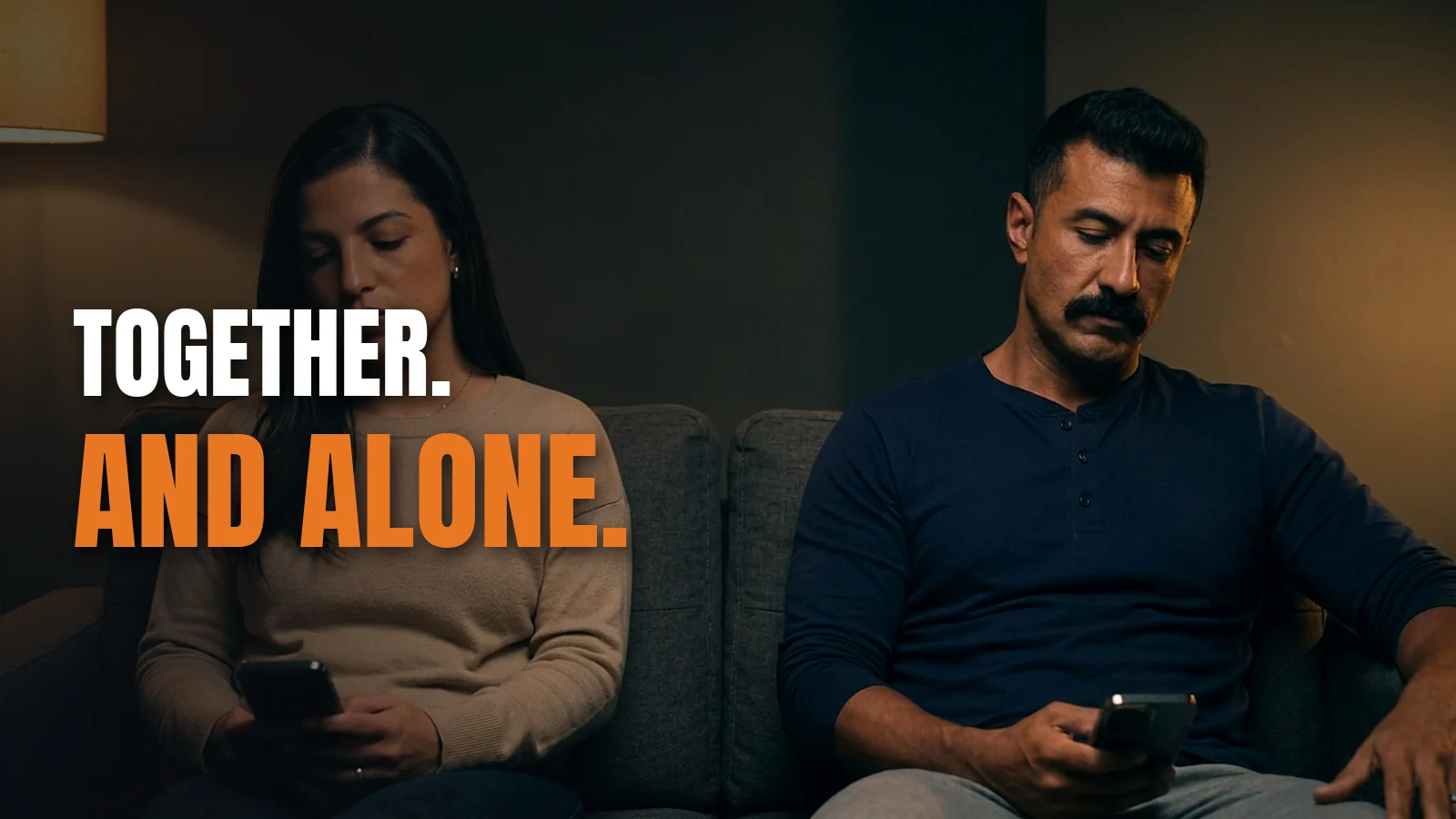
It’s the couple who talk all day about bills, school pickups and schedules, but never about anything that matters. It’s the husband who walks in, turns on the TV and checks out. It’s the wife who has stopped explaining how she feels because “what’s the point.” Two people on the same couch, each on a phone, each on an island.
Scripture speaks to this on its very first pages:
“The LORD God said, ‘It is not good for the man to be alone. I will make a helper suitable for him.’” (Genesis 2:18, NIV)
Notice: Adam wasn’t physically alone. He had God, the garden, the animals. Still, God said, “It is not good.” Marriage was designed to be the answer to loneliness — not one more place where it lives.
When 26.6% of married people say they felt lonely, I don’t read that as proof that marriage has failed. I read it as a warning that many marriages are running like business partnerships instead of covenants.
Conflict that isolates
The finding about family conflict bothers me most, because I used to be the problem in my own marriage. I know what it’s like to live in a house where every conversation turns into a fight. After a while, nobody risks opening their heart anymore, because opening your heart has become handing the other person ammunition.
Constant fighting doesn’t just hurt. It isolates. Each person shuts down to protect themselves, and the silence that follows feels like peace — but it’s distance.
Ecclesiastes describes the opposite:
“Two are better than one, because they have a good return for their labor: If either of them falls down, one can help the other up. But pity anyone who falls and has no one to help them up.” (Ecclesiastes 4:9-10, NIV)
A husband and wife were made to be the first ones to pick each other up. When home becomes a battlefield, whoever falls stays down — even with someone right beside them.
The phone in the middle of the bed
I won’t repeat everything we’ve said about screens. But the social media finding matches what I see in couples: hours scrolling through other people’s lives, and minutes — at best — looking into the eyes of the person next to us. Social media promises connection with the whole world and often steals connection with the one person who promised to stay.
This isn’t about demonizing your phone. It’s about asking honestly: how much of my best time and attention goes to a screen, and how much goes to my wife, to my husband?
A cord of three strands needs community
There’s a part of this survey many people will skip, and I want to highlight it: friends, volunteering and church all showed up on the protective side. That doesn’t surprise me. A couple was never meant to lock the door and carry everything alone.
I’ve written here about men without friends and why your wife can’t be your only person. It applies to both spouses. Marriage is the center, but it isn’t an island. We need brothers and sisters who know our story, who pray for us and who have permission to challenge us.
“And let us consider how we may spur one another on toward love and good deeds, not giving up meeting together, as some are in the habit of doing.” (Hebrews 10:24-25, NIV)
And the cord of three strands in Ecclesiastes 4:12 “is not quickly broken” because there is a third strand. For us, that strand is Christ. A couple that prays together, is planted in a faith community and doesn’t hide has a far better chance of making it through seasons of loneliness.
What to do this week
No magic formula — just four simple steps:
- Ask the hard question. Ask your spouse, “Have you been feeling lonely with me?” — and listen without defending yourself.
- Create 15 screen-free minutes a day. No phone, no TV. Just the two of you, talking about something beyond household logistics.
- End an old fight. Ask forgiveness for your part, with no “but.” Reconciliation starts with whoever decides to take the first step.
- Leave the island. Get back to church, reach out to a couple you trust, say yes to that small-group invitation.
And an important word: persistent loneliness, deep sadness or thoughts of ending your life are not a lack of faith. They are signs to get help. Talk to a licensed mental health professional and to your pastor. If you are in crisis in the U.S., call or text 988 (Suicide & Crisis Lifeline); in Brazil, call CVV at 188; or seek emergency care.
God sets the lonely in families
Jesus knew loneliness. In Gethsemane He asked His closest friends, “My soul is overwhelmed with sorrow to the point of death. Stay here and keep watch with me” (Matthew 26:38, NIV). They fell asleep. He understands what it’s like to feel alone in a crowd.
And He is the same God of whom the psalmist says:
“God sets the lonely in families.” (Psalm 68:6, NIV)
If your home has become a place of two lonelinesses, it doesn’t have to stay that way. Trust is rebuilt brick by brick, and so is intimacy. It starts with one honest conversation, one apology, one prayer together.
For more honest, Christ-centered conversations about marriage, follow Ricardo Martins and Vanessa Lima — O Casal Legendário — on YouTube and on Instagram at @ocasallegendario.
Sources
- Solidão é o fator mais ligado à pior saúde mental no Brasil, mostra pesquisa (Loneliness is the factor most linked to poor mental health in Brazil) — Folha de S.Paulo, Oct 24, 2026
- Panorama da Saúde Mental 2026 — 5th edition (full report, PDF, Portuguese) — Instituto Cactus + AtlasIntel, 2026
- Panorama da Saúde Mental (official site) — Instituto Cactus
Ricardo Martins
Ricardo Martins is an author, pastor and spokesperson for the Legendários men's movement. With his wife, Vanessa Lima, he created The Legendary Couple (O Casal Legendário), reaching millions with content on Christian marriage and restoration. Author of "Quando o amor recomeça" (Citadel, 2026).
Want to talk with Ricardo & Vanessa?
Follow the daily videos on YouTube and Instagram — real testimony, practical steps, and hope for marriages that look finished.
Watch on YouTubeKeep reading
November Blue: 77,000 Prostate Cancer Cases a Year in Brazil — and the Man Who Cares for Everyone but Himself
As Brazil's "November Blue" men's health campaign began, CNN Brasil reported that the National Cancer Institute (INCA) projects 77,920 new prostate cancer cases a year through 2028, and that shame and fear keep many men from addressing it. Ricardo Martins reflects on the male pride that postpones health — and the couple's role in it.
Read article →
Mental health is Brazil's top health worry — and marriages are right in the middle of it
Ipsos' Health Service Report 2026, covered by Folha de S.Paulo, finds 58% of Brazilians name mental health as their country's biggest health problem, with a 21-point gap between women (68%) and men (47%). Ricardo Martins reflects on what that gap looks like inside a marriage and how a couple can become each other's first line of care.
Read article →
Brazilian Weddings Ran 22% Over Budget in 2026 — and the Honeymoon Got Cut First
A Casar.com and Serasa survey reported by Valor Investe shows Brazilian couples planned to spend R$45,800 on their wedding and ended up spending R$56,200; 62.5% cut back on or gave up the honeymoon to avoid debt. Ricardo Martins comments on what that says about a couple's priorities.
Read article →This content is educational and pastoral. It does not replace therapy, medical, legal or emergency help. If you are in danger, seek help now.