November Blue: 77,000 Prostate Cancer Cases a Year in Brazil — and the Man Who Cares for Everyone but Himself
As Brazil's "November Blue" men's health campaign began, CNN Brasil reported that the National Cancer Institute (INCA) projects 77,920 new prostate cancer cases a year through 2028, and that shame and fear keep many men from addressing it. Ricardo Martins reflects on the male pride that postpones health — and the couple's role in it.
 By Ricardo Martins
Published November 4, 2026 · 7 min read
The news
On Sunday, November 1, Brazil kicked off Novembro Azul (“November Blue”), its annual men’s health and prostate cancer awareness month. CNN Brasil opened the month with a sobering reminder: after skin cancer, prostate cancer is the most common tumor among Brazilian men. According to the official estimate from INCA, Brazil’s National Cancer Institute, the country will see 77,920 new cases per year from 2026 through 2028 — about 74.6 cases per 100,000 men.
The report also cites Brazil’s national mortality database (SIM/DATASUS), released in September: 11,257 deaths from the disease in 2026 alone, roughly 46 a day. And it names the reason that caught my attention most: out of shame or fear, many men simply don’t talk about it and put off getting checked.
One honest detail that rarely makes the headlines: doctors and health authorities don’t fully agree on routine testing. Brazil’s Ministry of Health and INCA recommend against population-wide screening of men without symptoms, citing false positives and overtreatment. The Brazilian Society of Urology, on the other hand, encourages a screening conversation starting at 50 (earlier for higher-risk groups). I’m not a doctor, and I won’t settle that debate here. Both sides agree on one thing: the decision is personal and should be made with a physician. That’s exactly the conversation so many men never have.
The man who cares for everyone but himself
I know this man. Sometimes I see him in the mirror.
He’s the guy who takes the car in for service right on schedule, checks the tires on his wife’s car before a road trip, and never misses a payment on the kids’ health insurance. He protects everybody. But when it comes to his own body, he becomes an expert in three phrases: “It’s nothing,” “I’ll look into it later,” and “Real men don’t run to the doctor for every little thing.”
Today I also published a piece on male pride and money in marriage. November Blue exposes the same root from another angle. The pride that won’t admit it needs help is the same pride that won’t admit it’s vulnerable. And for a lot of us, vulnerability sounds like weakness.
I went through burnout and needed professional help to climb out of that hole. One thing I learned the hard way: a man who refuses to be cared for doesn’t become stronger — he becomes lonelier. And sooner or later, the whole household pays the bill.
Your body isn’t only yours
There’s a verse we usually quote about sex and purity, but it applies just as much here:
“Do you not know that your bodies are temples of the Holy Spirit, who is in you, whom you have received from God? You are not your own; you were bought at a price. Therefore honor God with your bodies.” (1 Corinthians 6:19-20, NIV)
You are not your own. Neglecting your health often dresses up as toughness, but underneath it is a lie: that my life belongs only to me. It doesn’t. It was bought at a price, at the cross. And in marriage, it was also given to someone else.
Paul goes further when he speaks to husbands:
“In this same way, husbands ought to love their wives as their own bodies. He who loves his wife loves himself. After all, no one ever hated their own body, but they feed and care for their body, just as Christ does the church.” (Ephesians 5:28-29, NIV)
Notice the logic. Paul uses caring for your own body as the obvious standard — the bare minimum — to teach a husband how to love his wife. He assumes every man looks after himself. When we don’t even do that, we’ve dropped below the minimum.
Taking care of your health isn’t vanity. It’s stewardship. It’s love for the woman who would sleep alone if you were gone, and for the kids who are learning, by watching you, how a man treats his own body.
“Honey, just make the appointment”
Now a word for couples, because this issue is rarely solved inside the man’s head alone.
Many wives have stopped bringing it up because every reminder turns into a fight. He hears “go see a doctor” and translates it as “you’re weak,” or “you’re getting old,” or “you can’t handle it.” And he answers with irritation, a joke, or silence.
Proverbs describes the scene well:
“The way of fools seems right to them, but the wise listen to advice.” (Proverbs 12:15, NIV)
Husband, the woman asking you to see a doctor isn’t belittling you. She’s doing exactly what God said she would when He called her “a helper suitable” for you (Genesis 2:18): she sees what you’d rather not look at. Listening to that advice isn’t surrender. It’s wisdom.
Wife, a few things help:
- Trade the complaint for the reason. “I want to grow old with you” lands very differently from “You never take care of yourself.”
- Do it together. Booking both of your checkups in the same month removes the “you’re the problem” weight.
- Pick your moment. Health brought up in the middle of an argument about something else becomes ammunition, not care.
- Pray before you speak. Sometimes his fear is bigger than he can say out loud.
Prudence is also faith
Some Christian men confuse neglect with faith: “God is in control, I don’t need a doctor.” God is in control. And He’s the one who wrote:
“The prudent see danger and take refuge, but the simple keep going and pay the penalty.” (Proverbs 22:3, NIV)
Faith isn’t closing your eyes to risk. Faith is trusting God while you do your part responsibly. Luke was a physician, and he traveled with Paul. Going to an appointment isn’t a lack of faith. Avoiding one out of pride might be.
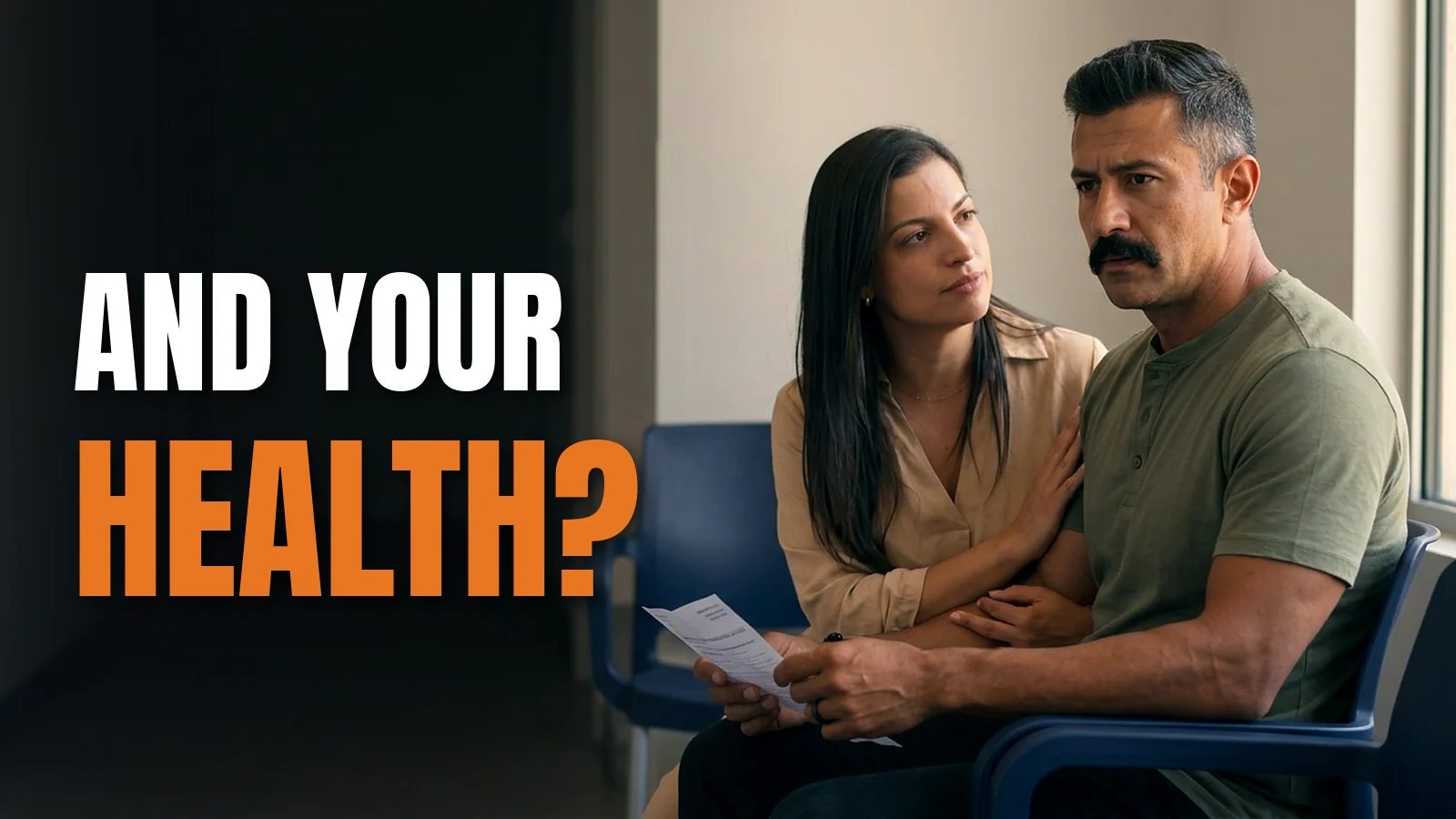
In the Legendários movement, I’ve learned that a man’s courage isn’t measured only at the top of a mountain. Very often it shows up in a waiting room, in a plain T-shirt, with a lab order in his hand and his wife by his side.
One step for this week
I’m not here to tell you which test to take — that’s between you and your doctor. But I can ask you a pastoral question: when was the last time you talked to a doctor about your health — not because something hurt, but because your life matters to the people who depend on you?
If that question made you uncomfortable, it did its job. Book it. Tell your wife you booked it. And let her come along if she wants to.
“Teach us to number our days, that we may gain a heart of wisdom.” (Psalm 90:12, NIV)
Numbering our days isn’t about fearing death. It’s about living in a way that honors each one of them — and the people God has placed inside them.
If pride has been speaking louder than love in your home, in more areas than just health, Vanessa Lima and I talk about this every week on O Casal Legendário’s YouTube channel and Instagram. Come walk with us — one honest step at a time, with Christ at the center.
This article is a pastoral reflection and is not a substitute for medical advice. For decisions about testing and screening, talk with a healthcare professional.
Sources
- Novembro Azul: câncer de próstata é o segundo tipo mais comum em homens (November Blue: prostate cancer is the second most common cancer in men) — CNN Brasil, Nov 1, 2026
- 2026–2028 Estimate — Summary of results: prostate cancer (Portuguese) — Brazilian National Cancer Institute (INCA)
- Ministry of Health recommends against population-wide prostate cancer screening (Portuguese) — INCA / Brazilian Ministry of Health, 2023
- Novembro Azul: câncer de próstata mata 50 por dia no Brasil (Brazilian Society of Urology position) — O Tempo, Nov 1, 2026
Ricardo Martins
Ricardo Martins is an author, pastor and spokesperson for the Legendários men's movement. With his wife, Vanessa Lima, he created The Legendary Couple (O Casal Legendário), reaching millions with content on Christian marriage and restoration. Author of "Quando o amor recomeça" (Citadel, 2026).
Want to talk with Ricardo & Vanessa?
Follow the daily videos on YouTube and Instagram — real testimony, practical steps, and hope for marriages that look finished.
Watch on YouTubeKeep reading

Lonely in Marriage: 1 in 4 Married Brazilians Felt Alone, Survey Finds
Brazil's 2026 Mental Health Panorama (Instituto Cactus and AtlasIntel), reported by Folha de S.Paulo, found loneliness to be the factor most linked to poor mental health. Married people felt lonely far less often than singles, yet 26.6% of them still did. Ricardo Martins reflects on loneliness inside marriage.
Read article →
Mental health is Brazil's top health worry — and marriages are right in the middle of it
Ipsos' Health Service Report 2026, covered by Folha de S.Paulo, finds 58% of Brazilians name mental health as their country's biggest health problem, with a 21-point gap between women (68%) and men (47%). Ricardo Martins reflects on what that gap looks like inside a marriage and how a couple can become each other's first line of care.
Read article →
Brazilian Weddings Ran 22% Over Budget in 2026 — and the Honeymoon Got Cut First
A Casar.com and Serasa survey reported by Valor Investe shows Brazilian couples planned to spend R$45,800 on their wedding and ended up spending R$56,200; 62.5% cut back on or gave up the honeymoon to avoid debt. Ricardo Martins comments on what that says about a couple's priorities.
Read article →This content is educational and pastoral. It does not replace therapy, medical, legal or emergency help. If you are in danger, seek help now.