Anger in men: “in your anger do not sin” at home
The slammed door, the fist on the table, the heavy silence. Ricardo Martins writes to husbands about the anger that runs a home, what Ephesians 4, James 1 and Proverbs teach about self-control, and five practical steps for a man to stop blowing up at the people he loves most.
 By Ricardo Martins
Published November 3, 2026 · 8 min read
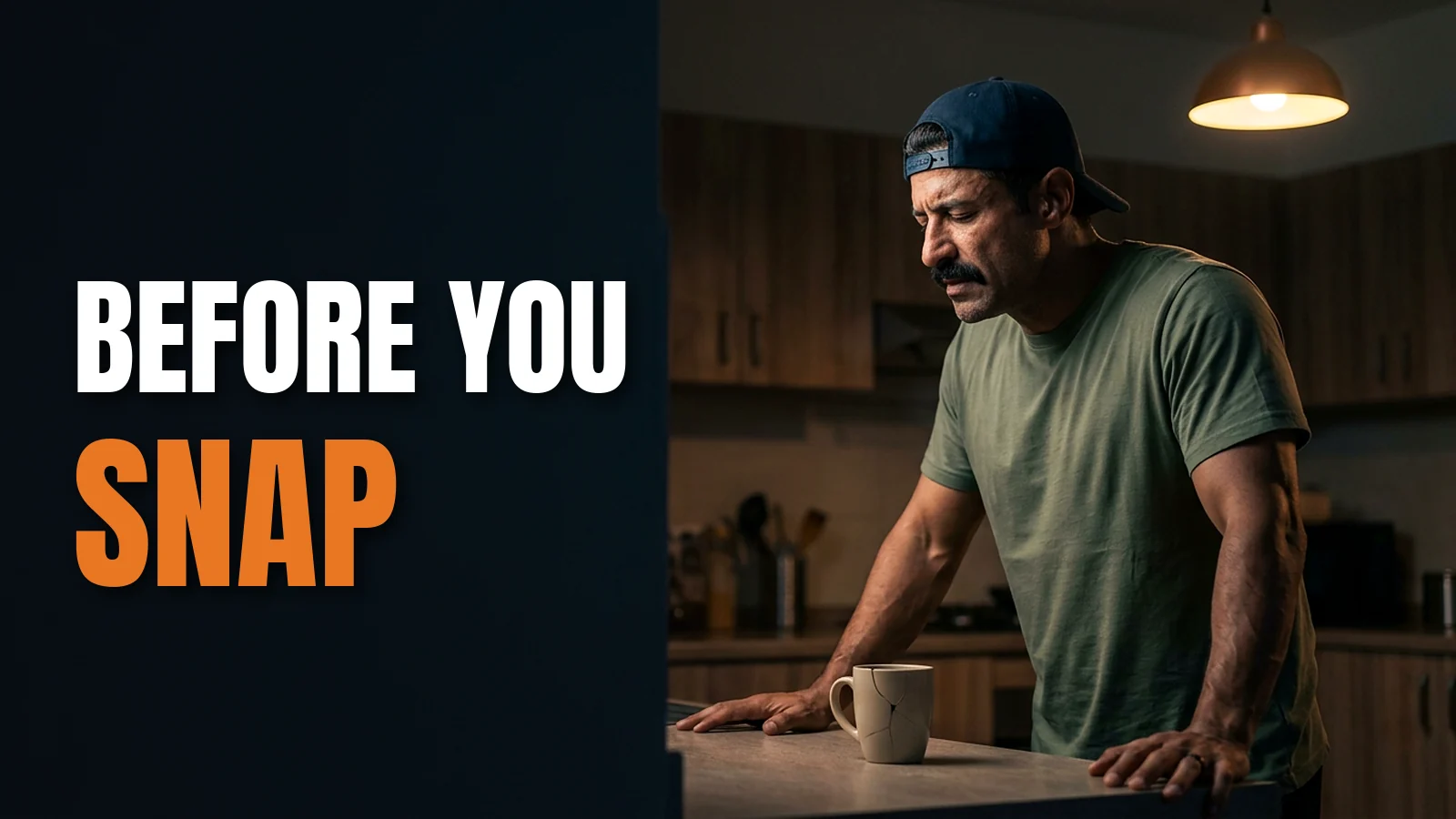
He pulls into the driveway. Nobody has said a word yet, but everybody already knows. His wife notices how hard he shut the truck door. The kids read his forehead. In two seconds everyone knows if tonight is an eggshell night.
This man has never hit anyone. He doesn’t cheat. He pays the bills. He’s in church on Sunday. And if you asked him, he’d tell you honestly: “I’m not violent. I just have a short fuse.”
But a short fuse at home has a biblical name. And it has a cost. He’s not the one who pays it. The people who live with him are.
Paul didn’t forbid anger. He forbade what it turns into
““In your anger do not sin”: Do not let the sun go down while you are still angry, and do not give the devil a foothold.” — Ephesians 4:26-27 (NIV)
I’ve written before about how to fight fair in marriage, and there the focus was “don’t let the sun go down.” Today I want to look at the end of the verse, the part we usually skip: “do not give the devil a foothold.”
A foothold is a small ledge, just enough to start climbing. Paul is saying unmanaged anger doesn’t sit still. It gives the enemy something to stand on. All it takes is a man who thinks raising his voice is normal, who treats his bad mood as a right he’s earned, who excuses harshness with “that’s just how I am.”
There is an anger that isn’t sin. Jesus felt it:
“He looked around at them in anger and, deeply distressed at their stubborn hearts, said to the man, “Stretch out your hand.”” — Mark 3:5 (NIV)
Notice two things. Jesus was angry at hard hearts that stood in the way of a man being healed, not at someone who interrupted his evening. And his anger came with grief: “deeply distressed.” Holy anger grieves for others. Ours usually just protects our ego.
A man’s anger is rarely about what it looks like
“Because human anger does not produce the righteousness that God desires.” — James 1:20 (NIV)
The wet towel on the bed, the kid who spilled the juice, your wife saying “again?” in the wrong tone. None of that is the cause. It’s the trigger.
When a man blows up over something small, there’s almost always something big underneath. Bruised pride at work. Fear about money. Exhaustion. The feeling of not being respected. Frustration that life didn’t turn out the way he planned. It all fills the tank, and the wet towel is just the drop that makes it spill over.
God asked the Bible’s first angry man exactly this:
“Then the LORD said to Cain, “Why are you angry? Why is your face downcast? If you do what is right, will you not be accepted? But if you do not do what is right, sin is crouching at your door; it desires to have you, but you must rule over it.”” — Genesis 4:6-7 (NIV)
Before Cain ever raised a hand against Abel, God asked “why?” His anger had a root: envy, rejection, comparison. And God warned him that sin was crouching at the door like an animal waiting to pounce. Cain refused to look inside. We know how that ends.
The first question an angry man needs to learn to ask isn’t “who set me off?” It’s “what’s going on inside me?”
Biblical strength is control, not volume
Our culture sells a picture of a strong man: the loudest guy in the room, the one who “lays down the law” by yelling. Scripture turns that picture upside down.
“Better a patient person than a warrior, one with self-control than one who takes a city.” — Proverbs 16:32 (NIV)
Taking a city is a general’s job. Solomon says there’s a bigger victory: ruling your own spirit. The man who holds his tongue, takes a breath and chooses his words is stronger than the man who kicks the door in.
“Fools give full vent to their rage, but the wise bring calm in the end.” — Proverbs 29:11 (NIV)
Saying everything you feel the moment you feel it isn’t “being real.” The Bible calls it foolishness. Biblical manhood isn’t a man without emotions. It’s a man whose emotions don’t run him.
Who pays the bill at home
When Paul speaks directly to husbands, he puts his finger right on this:
“Husbands, love your wives and do not be harsh with them.” — Colossians 3:19 (NIV)
He wouldn’t have needed to write that if it weren’t a real temptation. There’s a kind of husband who isn’t violent, but he’s harsh. He corrects with contempt. He answers with sarcasm. He turns home into a place where his wife edits every sentence before she says it. That isn’t leadership. It’s fear dressed up as authority.
And the kids are watching:
“Fathers, do not exasperate your children; instead, bring them up in the training and instruction of the Lord.” — Ephesians 6:4 (NIV)
A child who grows up with an explosive dad learns one of two lessons: that love and fear go together, or that this is how men handle things. Neither is the legacy you want to leave.
Five steps to stop blowing up
1. Know your warning signs. Anger sends a text before it shows up: a clenched jaw, a rising voice, a racing heart, heat in your chest. Learn your signal. The man who notices at second one has a chance. The man who notices at second ten has already said what he shouldn’t.
2. Leave the room, but say you’re coming back. “I’m getting angry and I don’t want to hurt you. I’m going to take a walk, and then I’ll come back so we can talk.” That isn’t running away. Running away is disappearing without a word. A timeout with a promise to return is self-control in action.
3. Answer the question Cain wouldn’t. During the pause, ask yourself: what’s underneath this? Exhaustion? Shame? Fear? Often, once you name the root, the anger loses half its strength.
4. Ask forgiveness from the people you hurt, including your kids. A dad who gets down to his son’s eye level and says, “Dad was wrong to yell at you. Will you forgive me?” teaches more about the gospel than a lot of sermons. It builds real authority.
5. Don’t fight this alone. “Therefore confess your sins to each other and pray for each other so that you may be healed” (James 5:16, NIV). Have a trusted brother, a pastor or a men’s group you can tell, “I lost it three times this week.” Hidden sin grows. Confessed sin loses its grip.
When anger becomes fear, it’s a different conversation
I need to be clear here. If your anger includes threats, breaking things, cornering, pushing, or controlling your wife’s money or movements, that isn’t “a strong personality.” It’s abuse, and it calls for specialized help beyond pastoral counseling. Reach out to a licensed professional and a pastor you trust now, not after the next blowup.
And if you’re a wife reading this and you’re afraid in your own home: your safety comes first. In the U.S., the National Domestic Violence Hotline is 1-800-799-7233; if you’re in immediate danger, call 911. Seeking protection isn’t a lack of faith or a failure to honor your husband.
Grace reaches angry men too
Maybe you’ve read this far with a lump in your throat, remembering the last time you yelled. I didn’t write this to crush you. I wrote it because there’s a way out.
“Get rid of all bitterness, rage and anger, brawling and slander, along with every form of malice. Be kind and compassionate to one another, forgiving each other, just as in Christ God forgave you.” — Ephesians 4:31-32 (NIV)
Look at the foundation: “just as in Christ God forgave you.” You won’t become a gentle man by sheer willpower. Self-control shows up in the list of the fruit of the Spirit (Galatians 5:22-23), not in a list of personal achievements. It’s Christ forming in you a heart that doesn’t need to explode to be respected.
Tonight, before the sun goes down, there may be a conversation you need to have. Start there.
Ricardo Martins
Ricardo Martins is an author, pastor and spokesperson for the Legendários men's movement. With his wife, Vanessa Lima, he created The Legendary Couple (O Casal Legendário), reaching millions with content on Christian marriage and restoration. Author of "Quando o amor recomeça" (Citadel, 2026).
Want to talk with Ricardo & Vanessa?
Follow the daily videos on YouTube and Instagram — real testimony, practical steps, and hope for marriages that look finished.
Watch on YouTubeKeep reading

When she earns more: male pride and money in marriage
Your wife got the promotion, her paycheck passed yours, and something shifted inside you. Ricardo Martins writes to husbands about the pride hiding behind a paycheck, what Proverbs 31, Mark 10 and 1 Peter 3 teach about leadership, and five practical moves to keep her income from becoming a silent war.
Read article →
The Invisible Fight: How Unpaid Housework Quietly Turns Into Resentment in Marriage
Federal time-use data show women in the U.S. spend about 2.3 hours a day on household activities versus 1.7 for men — and in Brazil the gap is nearly 10 hours a week. Ricardo Martins explains how that gap becomes silent resentment in marriage, and what a Christian husband does about it.
Read article →
Men Without Friends: Why Your Wife Can't Be Your Only Person
The share of American men with no close friends jumped from 3% to 15% since 1990, and 85% of married men say their wife is the first person they turn to with a personal problem. Ricardo Martins explains why that weighs on a marriage and how Christian men can rebuild real friendships.
Read article →This content is educational and pastoral. It does not replace therapy, medical, legal or emergency help. If you are in danger, seek help now.