Faithful Christian Couples Have the Happiest Marriages in America: What the New Report Proves (and What It Doesn't)
A new Institute for Family Studies report, "The Devout Difference," finds churchgoing couples are happier, divorce less and have more active intimate lives. Ricardo Martins comments on what the data means for anyone fighting for their marriage.
 By Ricardo Martins
Published September 25, 2026 · 6 min read
The news
This week the Institute for Family Studies (IFS) released The Devout Difference, a report by Rich Dell’Isola, Brad Wilcox, Grant Bailey and Jane Lankes Smith based on a YouGov survey and General Social Survey data. According to the IFS summary, 79% of churchgoing Catholics and 74% of churchgoing Protestants say they are very happily married, compared with 66% of non-religious spouses. Churchgoers are 39% more likely to be married, and spouses who embrace marriage as a lifelong commitment have 1.85 times higher odds of being happily married. The report also finds that 62% of churchgoing spouses have sex at least weekly, versus 48% of non-religious spouses. And it doesn’t hide the problem: 25% of churchgoing husbands view pornography monthly or more (versus 35% of husbands who rarely or never attend).
One honest note: the report was sponsored by FOCUS, a Catholic college ministry. That doesn’t invalidate the data, but you should know it.
From here on, this is my opinion — as a pastor, a husband, and a man who was once the problem in his own marriage.
Before you celebrate, breathe
I know the temptation. A believer sees a headline like this and wants to drop it in the family group chat: “See? People with Jesus are happier.” I get it. But I want to be honest with you, because honesty saves marriages. Slogans don’t.
First: a survey shows association, not proof of cause. It may be that naturally committed people are both the ones who go to church and the ones who stay married. The researchers themselves treat their numbers with that care.
Second: notice the data isn’t about people who call themselves Christians. It’s about people who practice. The same report shows that nominal Protestants — those who identify as Protestant but rarely attend — have high divorce rates. A Christian name tag has never saved anyone’s marriage.
Third: 74% happy means one in four couples sitting in those pews, Sunday after Sunday, is not very happy. Maybe that’s you. Maybe you’re reading this after another service where you both smiled at friends in the parking lot and drove home in silence.
If that’s you, this is for you.
It’s not the building. It’s the rock.
Jesus ended the Sermon on the Mount with an image every builder understands: “Therefore everyone who hears these words of mine and puts them into practice is like a wise man who built his house on the rock” (Matthew 7:24, NIV).
Look at the verb: puts them into practice. Both houses in the parable faced the same rain, the same wind, the same flood. The difference wasn’t the storm. It was the foundation.
That’s what I read in this report. It’s not that practicing Christians have fewer problems. It’s that they have something to hold on to when problems come. A community that notices when they disappear. A Word that confronts their pride. A God before whom they kneel — and it’s hard to keep thinking you’re always right after you’ve been on your knees.
I was once the problem in my marriage. I didn’t get out of that hole because I was smarter or stronger. I got out because Vanessa gave God a chance, and God started working on me. Trust came back brick by brick. But the foundation wasn’t us. It was Him.
The number that caught my attention
It wasn’t the happiness. It was the 1.85.
Couples who believe in the permanence of marriage — who don’t leave the back door open — have nearly double the odds of being happy. That contradicts everything our culture teaches. The culture says: “Don’t get trapped, keep your options open, if you’re not happy, leave.” And the data suggests the opposite: the people who close the back door are the ones who find joy inside the house.
Jesus said: “So they are no longer two, but one flesh. Therefore what God has joined together, let no one separate” (Matthew 19:6, NIV). That isn’t a prison. It’s security. Nobody gives themselves fully to someone whose suitcase is half packed.
Let me be clear: permanence never means enduring abuse or violence. Where there is danger, safety comes first, always. I’m talking about the ordinary couple — tired, distant — who has thought about quitting because “the love is gone.”
Men, this number is about you
Now the number that hurts: one in four churchgoing husbands views pornography at least once a month.
Brother, it doesn’t help to serve as an usher on Sunday and be a slave to your phone on Tuesday. The same research that shows Christian couples are happier shows that many of us are quietly sabotaging it. And your wife feels it, even when she doesn’t know. She feels it in the distance, the irritability, the way your eyes no longer linger on her.
“Do not merely listen to the word, and so deceive yourselves. Do what it says” (James 1:22, NIV). Going to church is good. But what transforms a marriage is practice: confessing, asking for help, being accountable to another man, cutting off what needs to be cut off. That’s exactly what I see happen with men in Legendários when they stop pretending.
Three practical steps for this week
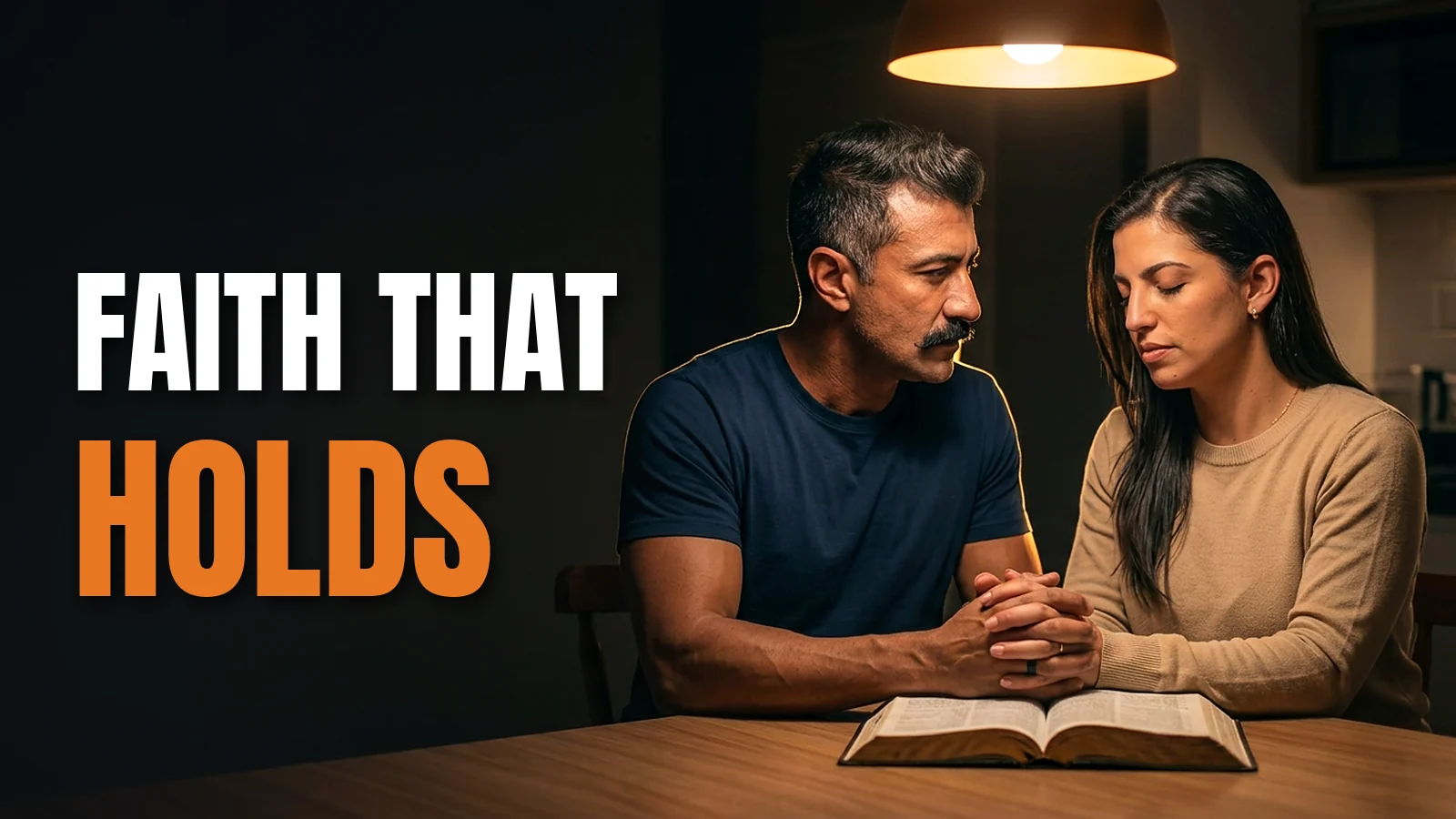
- Start praying together again, even for one minute. Holding hands, before bed. No fancy words. “Lord, take care of our marriage.” The awkwardness of the first few times is normal.
- Close the back door out loud. Tell your spouse: “I’m not leaving. Let’s work this out.” Sometimes that’s all the other person needs to hear to stop being defensive.
- Get out of anonymity. If you go to church but nobody there knows how you’re really doing, find an older couple, a pastor, a small group. Practiced faith is faith in community. And if the wounds run deep, look for a trusted professional too.
Closing
“A cord of three strands is not quickly broken” (Ecclesiastes 4:12, NIV). This American report, with all its limits, is simply measuring in numbers what the Bible has said for thousands of years: a marriage with God in the middle survives storms that two people alone cannot.
It’s not about religion. It’s about foundation. And foundations can be rebuilt — I’m living proof.
If this spoke to you, follow Vanessa Lima and me — O Casal Legendário — on YouTube and Instagram, where we share every week, with Christ at the center, how to rebuild a marriage on the rock.
Sources
- Faithful Christians Have the Happiest Marriages in America — Institute for Family Studies
- The Devout Difference: Religion, Marital Quality, and Sex Among Americans (report) — Institute for Family Studies
Ricardo Martins
Ricardo Martins is an author, pastor and spokesperson for the Legendários men's movement. With his wife, Vanessa Lima, he created The Legendary Couple (O Casal Legendário), reaching millions with content on Christian marriage and restoration. Author of "Quando o amor recomeça" (Citadel, 2026).
Want to talk with Ricardo & Vanessa?
Follow the daily videos on YouTube and Instagram — real testimony, practical steps, and hope for marriages that look finished.
Watch on YouTubeKeep reading
98% of Brazilian Women Change Their Routine Out of Fear: Is Your Home a Refuge or Another Risk?
A new survey by Brazil's Patrícia Galvão and Locomotiva institutes shows 98% of women adopt daily strategies to avoid violence, and six in ten fear domestic violence. Ricardo Martins comments on what that asks of every married man.
Read article →
In the U.S., Single Young Men Now Outnumber Married Ones Two to One
New Institute for Family Studies data shows 30.4 million unmarried men ages 20-39 in the United States in 2025, against 15.4 million married men. Ricardo Martins comments on what that number really says — and what it asks of those of us who are already married.
Read article →
In-laws, family of origin, and healthy boundaries in marriage
Honoring your parents is not the same as letting them run your marriage. Ricardo Martins explains what the Bible says about in-laws and how to set healthy boundaries without dishonoring anyone.
Read article →This content is educational and pastoral. It does not replace therapy, medical, legal or emergency help. If you are in danger, seek help now.