Empty nest: when the kids leave and it's just the two of you
When the last child moves out, many couples realize they became co-managers of the kids and forgot how to be husband and wife. Ricardo Martins draws on Genesis 2, Ecclesiastes 9 and two studies (Brown & Lin, 2012; Gorchoff, John & Helson, 2008) to show how the empty nest can be a crisis or a fresh start.
 By Ricardo Martins
Published October 27, 2026 · 7 min read

The car pulls out of the driveway with the last box of dorm supplies. You walk back inside, and the house feels different. Their bed is made a little too perfectly. The kitchen table suddenly seems huge. Nobody is yelling down the hall about a missing charger.
And for the first time in twenty-something years, it’s just the two of you. He looks at her. She looks at him. And somebody thinks — even if nobody says it out loud: “So… what do we talk about now?”
That’s the empty nest. For some couples, it turns into the best season of their marriage. For others, it’s the moment they discover they were married to the kids’ schedule, not to each other.
When the kids become the glue
For years, family life revolved around the children. School drop-offs, practices, doctor’s appointments, recitals, SATs, college applications. You two became a remarkably efficient management team: “You grab her, I’ll take him.” “You cover this bill, I’ll cover that one.” “Your turn to have the talk.”
It worked. The kids grew up. But somewhere in all that logistics, a lot of husbands and wives stopped dating, stopped dreaming out loud, stopped praying together, stopped laughing for no reason. Nobody decided that. It was a slow drift.
When the last kid leaves, the glue leaves with them. And whatever was hiding underneath shows up: two polite, tired, almost-strangers sharing an address.
“Gray divorce” is real
Sociologists Susan Brown and I-Fen Lin of Bowling Green State University dug into national U.S. data and published a 2012 study with a name that stuck: The Gray Divorce Revolution.
Here’s what they found:
- The divorce rate for adults 50 and older doubled between 1990 and 2010 — while the overall U.S. divorce rate stayed basically flat.
- By 2010, roughly 1 in 4 people getting divorced was 50 or older. In 1990, it was fewer than 1 in 10.
- The risk was 2.5 times higher in remarriages than in first marriages, and it dropped the longer a couple had been married.
The takeaway for any home: a long marriage is not a bulletproof marriage. Plenty of people “stay for the kids” — and when the kids go, they can’t find a reason to stay.
The good news almost nobody tells you
Now for the other half of the story — and this one gives me real hope.
Researchers at UC Berkeley — Sara Gorchoff, Oliver John and Ravenna Helson — followed a group of women for 18 years, from their early 40s into their early 60s, and published the results in Psychological Science in 2008.
Marital satisfaction actually went up in midlife. And women who had moved into the empty nest were more satisfied with their marriages than women who still had kids at home.
Here’s the part I love: it wasn’t because they spent more time with their husbands. It’s that they enjoyed that time more. Quality, not quantity. And the lead author’s advice is worth framing: don’t wait until your kids leave home to schedule time you actually enjoy with your spouse.
So the same empty nest that breaks some marriages makes others bloom. The difference isn’t the empty bedroom. It’s what you’ve done — or are about to do — with your marriage.
God’s design was always the couple
Here’s a truth a lot of Christian families forget: kids are meant to leave. They’re a gift from the Lord, but they’re on loan. Marriage is the part that was built to stay.
“That is why a man leaves his father and mother and is united to his wife, and they become one flesh.” (Genesis 2:24, NIV)
Notice that the very verse that establishes marriage already assumes the kids will go. One day your son or daughter will leave father and mother. That’s not a tragedy — it’s God’s design working the way He drew it up. And when they go, what remains is exactly what God joined at the start: one flesh.
The prophet Malachi describes a wife as “your partner, the wife of your marriage covenant” (Malachi 2:14, NIV). Not “the mother of your kids.” Partner. Covenant. Children pass through the house; the covenant lives there.
Guys, this one’s for you
A lot of times the husband feels the shift least. He’s got work, routines, projects. His wife, who may have organized her entire life around the kids, feels the floor drop out — and he doesn’t notice. Or he notices and has no idea what to do.
I was once the problem in my own marriage, so I’m not talking down to anybody. I’ve seen that by God’s grace a marriage can be rebuilt brick by brick, in any season. So take this as a challenge: the empty nest is your chance to pursue your wife all over again.
Five steps for empty-nest couples
1. Name the grief. Missing your kids, crying in their room, feeling lost — it’s normal. Don’t fake fine. Tell each other what you’re actually feeling.
2. Take an honest inventory. Ask: “What did we put on the back burner all these years? What hurt never got dealt with?” Some conversations you postponed “because of the kids” need to happen now — gently.
3. Get to know each other again. You’ve both changed. She’s not 25 anymore, and you’re not 27. Ask real questions, like it’s a first date. Arthur Aron’s 36 questions are a great place to start.
4. Build new rituals for two. A slow Saturday breakfast. An evening walk around the neighborhood. That road trip you kept putting off. Serving together at church. It’s not about logging more hours — it’s about enjoying the hours again.
5. Put Christ back at the center. Pray together. Open the Bible together. Couples who seek God side by side rediscover purpose, not just companionship.
Solomon put it this way: “Enjoy life with your wife, whom you love, all the days of this meaningless life that God has given you under the sun” (Ecclesiastes 9:9, NIV). All the days — not just the years when the kids gave the house its meaning.
Still have kids at home?
Then consider this a loving heads-up. Don’t wait for the nest to empty to find out you drifted apart. The marriage you tend today is the marriage that’s left tomorrow — and it’s also the marriage lesson your kids are watching right now.
A promise for the next season
Nobody has to face a quiet house alone. God doesn’t retire couples. The psalmist says the righteous “will still bear fruit in old age, they will stay fresh and green” (Psalm 92:14, NIV). And the Lord Himself promises: “Even to your old age and gray hairs I am he, I am he who will sustain you” (Isaiah 46:4, NIV).
Your kid’s bedroom may be empty. Your marriage doesn’t have to be. The best chapter for the two of you may not have even started yet.
If you feel like you’ve drifted, start today with one small, intentional step — one day at a time.
Sources
- Brown, S. L. & Lin, I.-F. (2012). The Gray Divorce Revolution: Rising Divorce Among Middle-Aged and Older Adults, 1990–2010. The Journals of Gerontology: Series B, 67(6), 731–741 — The Journals of Gerontology: Series B (Oxford University Press)
- Gorchoff, S. M., John, O. P. & Helson, R. (2008). Contextualizing Change in Marital Satisfaction During Middle Age. Psychological Science, 19(11), 1194–1200 — Psychological Science (Association for Psychological Science)
Ricardo Martins
Ricardo Martins is an author, pastor and spokesperson for the Legendários men's movement. With his wife, Vanessa Lima, he created The Legendary Couple (O Casal Legendário), reaching millions with content on Christian marriage and restoration. Author of "Quando o amor recomeça" (Citadel, 2026).
Want to talk with Ricardo & Vanessa?
Follow the daily videos on YouTube and Instagram — real testimony, practical steps, and hope for marriages that look finished.
Watch on YouTubeKeep reading
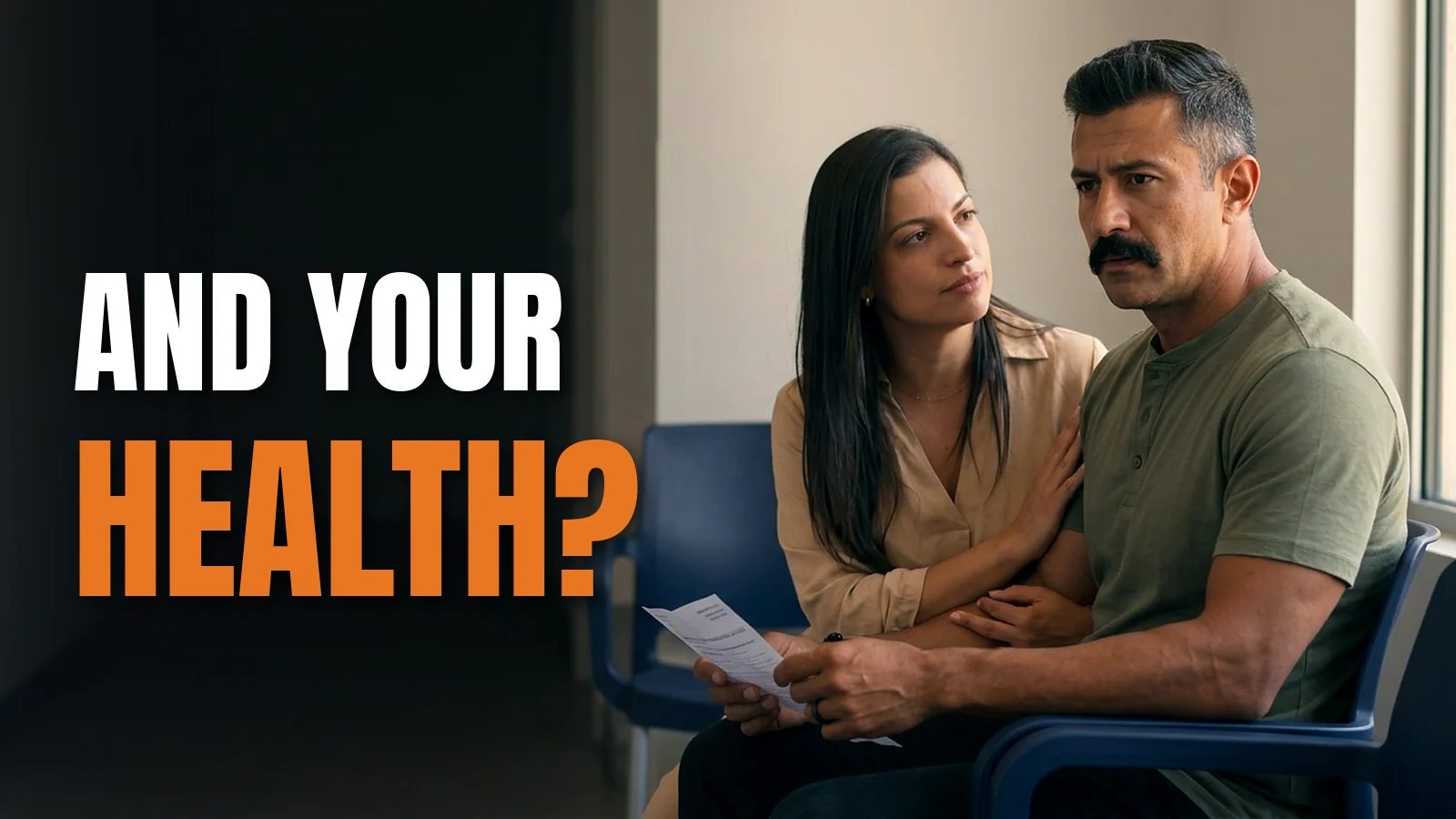
November Blue: 77,000 Prostate Cancer Cases a Year in Brazil — and the Man Who Cares for Everyone but Himself
As Brazil's "November Blue" men's health campaign began, CNN Brasil reported that the National Cancer Institute (INCA) projects 77,920 new prostate cancer cases a year through 2028, and that shame and fear keep many men from addressing it. Ricardo Martins reflects on the male pride that postpones health — and the couple's role in it.
Read article →
Daily gratitude in marriage: the small habit that shifts the atmosphere at home
The coffee that shows up on the table, the laundry folded, the bills paid — when nobody says thank you anymore, a marriage cools down. Ricardo Martins writes, with 1 Thessalonians 5, Luke 17 and a diary study of couples, about gratitude as a daily habit.
Read article →
Lonely in Marriage: 1 in 4 Married Brazilians Felt Alone, Survey Finds
Brazil's 2026 Mental Health Panorama (Instituto Cactus and AtlasIntel), reported by Folha de S.Paulo, found loneliness to be the factor most linked to poor mental health. Married people felt lonely far less often than singles, yet 26.6% of them still did. Ricardo Martins reflects on loneliness inside marriage.
Read article →This content is educational and pastoral. It does not replace therapy, medical, legal or emergency help. If you are in danger, seek help now.