Husbands Who Accept Influence: What Gottman’s Newlywed Study Found About Sharing Power
In a study of 130 newlywed couples followed for six years, John Gottman’s team linked one pattern to divorce — a husband who rejects his wife’s influence. Ricardo Martins walks through what the research found, what it can’t prove, and why listening to your wife is leadership, not weakness.
 By Ricardo Martins
Published October 16, 2026 · 7 min read
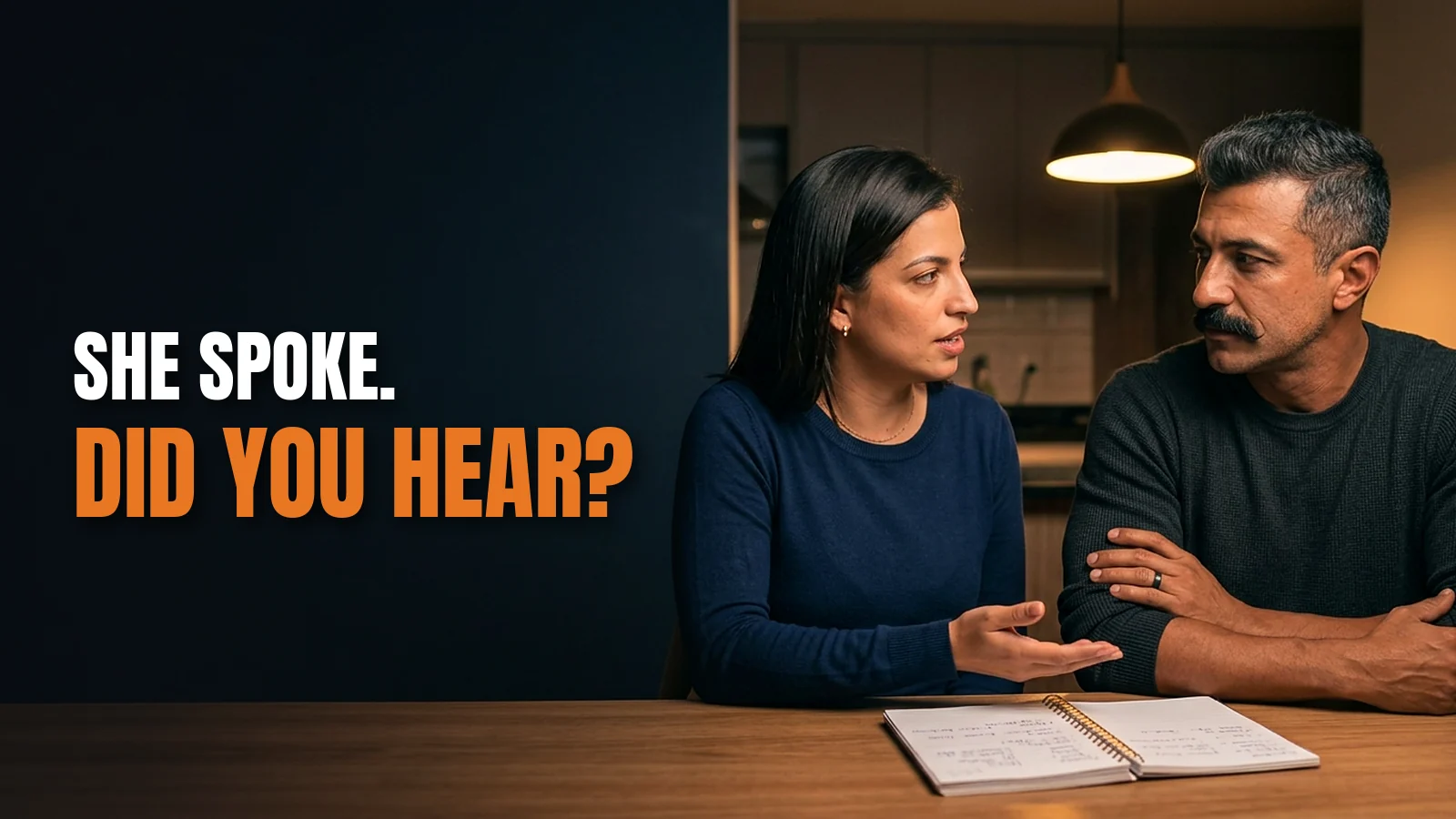
There’s a line I’ve heard from a lot of husbands, and maybe you’ve said it too: “I said what I said. End of discussion.”
It sounds strong. The guy thinks he’s leading — keeping the house from chaos, making sure somebody has the final word. But what his wife actually hears is something else: “Nothing you think changes anything around here.”
When that becomes a pattern, something in the marriage starts dying quietly.
What the study found
In 1998, psychologist John Gottman and three colleagues at the University of Washington — James Coan, Sybil Carrère and Catherine Swanson — published a study of 130 newlywed couples in the Journal of Marriage and the Family. They recorded couples working through a real disagreement, measured their physical stress responses, and then followed them for six years to see who stayed happily married, who stayed married but miserable, and who divorced.
The team tested seven different theories about what makes or breaks a marriage. A few that “everybody knew” didn’t hold up. Anger by itself didn’t predict divorce. And the classic counseling technique of “active listening” — paraphrasing your spouse, summarizing their feelings — barely showed up in the conversations of happy couples.
What did show up, according to the paper’s own abstract, was a cluster of patterns tied to divorce, including:
- the husband rejecting his wife’s influence;
- conversations that opened harshly (what the authors call negative start-up);
- the husband failing to cool things down when his wife raised a low-level complaint;
- and nothing helping the husband calm down physically once he was already flooded.
Using those patterns, the researchers’ models predicted which couples would divorce or stay together with 83% accuracy.
In the university’s press release, Gottman put it bluntly: “We found that only those newlywed men who are accepting of influence from their wives are winding up in happy, stable marriages.” He also noted that, in most couples, it was the wife who brought the issue up — usually with an analysis of the problem and a suggested solution already in hand.
In other words, a lot of the time she isn’t nagging. She’s handing you a map.
What the study doesn’t prove
I don’t do half-truths with science on this blog, so here’s the other side.
This study took real heat. In 2000, three well-respected researchers — Scott Stanley, Thomas Bradbury and Howard Markman — published a response in the same journal calling the recommendations “premature at best.” They pointed out that the couples weren’t randomly selected, that differences between couples at the start weren’t fully controlled for, and — most importantly — that the data are correlational. They show two things travel together; they don’t prove one causes the other.
It’s also 130 American couples studied in the 1990s. That’s a window, not a universal law.
So I’m not going to tell you that if you don’t listen to your wife, divorce is guaranteed. That would be a lie. What I will tell you is that this research lines up with something the Bible taught long before anyone built a marriage lab.
Accepting influence isn’t giving up leadership
This is where a lot of Christian men hit the brakes. “Wait — doesn’t the Bible call the husband the head?” It does. I’ve written about that in servant leadership in Ephesians 5.
But look at the verse that opens that whole passage: “Submit to one another out of reverence for Christ” (Ephesians 5:21, NIV). Before Paul talks about roles, he talks about posture. Nobody in that house is above correction.
Leadership isn’t having the last word. It’s carrying the final responsibility. And a responsible man wants the best decision — not just the one that came out of his own mouth.
Think about David. He was on his way to do something terrible — take revenge with his own hands — when Abigail met him on the road with wisdom and nerve. He could have said, “End of discussion.” Instead he stopped, listened, and turned around: “May you be blessed for your good judgment and for keeping me from bloodshed this day and from avenging myself with my own hands” (1 Samuel 25:33, NIV).
The future king of Israel didn’t lose authority by listening to a woman. He gained sense.
What accepting your wife’s influence looks like on a Tuesday night
It doesn’t mean agreeing with everything. It doesn’t mean becoming a passive husband who dumps every decision in her lap. It means letting what she thinks and feels actually carry weight. A few markers:
1. You hear her all the way out before you answer. “To answer before listening — that is folly and shame” (Proverbs 18:13, NIV). If you’re building your rebuttal while she’s still talking, you’re not listening. You’re waiting your turn.
2. You look for the part she’s right about. Even if you disagree with 80 percent, something in there is true. Start there: “You’re right about this part.” That sentence defuses more fights than any argument you’ll ever win.
3. You don’t escalate when she brings up something small. In the study, the problem wasn’t that wives got irritated. It was husbands turning a minor complaint into a war. Bringing the temperature down is your job.
4. You change your mind out loud. “I thought about it — you were right.” Your kids need to watch a man do that. It’s how they learn that strength and humility fit in the same body.
5. You decide with her, not just inform her. Money, moving, work, raising the kids. “I already handled it” is not the same as “let’s figure this out.” The first gets compliance, if you’re lucky. The second builds a partnership.
A word to wives
If you’ve read this far thinking, “My husband needs to see this,” I get it. But the same study also looked at how conversations begin. A harsh opening puts almost any man on the defensive.
I’m not putting this on you. I’m saying you hold a key to a door. Bring it up calmly, talk about what you feel instead of what he did wrong, pick the right moment. “The way of fools seems right to them, but the wise listen to advice” (Proverbs 12:15, NIV) — that one cuts both ways.
One important caveat: if “end of discussion” in your home comes with threats, humiliation, control over your money, or fear, that is not a communication problem. Reach out to someone you trust, a pastor trained for this, or a professional. If you’re in danger, call 911, or the National Domestic Violence Hotline at 1-800-799-7233.
The man who can be corrected
I was the problem in my own marriage. And here’s what I see in so many married men: they aren’t evil — they’re deaf. Deaf from pride, from the fear of looking weak, from believing that giving ground means losing.
But the gospel starts right there — with a man admitting he was wrong. Nobody surrenders to Christ without first conceding that his own way wasn’t working. A husband who has done that before God shouldn’t find it so hard to do in front of his wife.
“Everyone should be quick to listen, slow to speak and slow to become angry” (James 1:19, NIV).
Quick to listen. Not “willing, if there’s time.” Quick.
Try this this week: the next time your wife brings you an idea or a complaint, before you respond, ask her, “What else do you think we should do?” Then let something she says actually change what you were about to do.
Sources
- Gottman, Coan, Carrère & Swanson (1998). Predicting marital happiness and stability from newlywed interactions. Journal of Marriage and the Family, 60(1), 5–22 — Journal of Marriage and the Family (NCFR)
- Husband’s willingness to be influenced by wife, share power are key predictors of newlywed happiness, stability, UW study shows (Feb 20, 1998) — UW News — University of Washington (press release)
- Stanley, Bradbury & Markman (2000). Structural flaws in the bridge from basic research on marriage to interventions for couples. Journal of Marriage and the Family, 62(1), 256–264 — Journal of Marriage and the Family (critique of the 1998 study)
Ricardo Martins
Ricardo Martins is an author, pastor and spokesperson for the Legendários men's movement. With his wife, Vanessa Lima, he created The Legendary Couple (O Casal Legendário), reaching millions with content on Christian marriage and restoration. Author of "Quando o amor recomeça" (Citadel, 2026).
Want to talk with Ricardo & Vanessa?
Follow the daily videos on YouTube and Instagram — real testimony, practical steps, and hope for marriages that look finished.
Watch on YouTubeKeep reading
Servant leadership in marriage: what Ephesians 5 really says
Too many husbands have turned Ephesians 5 into a weapon. Ricardo Martins shows what the passage actually asks of the man, why leading in marriage means stepping down rather than taking charge, and what Christlike leadership looks like at home.
Read article →
Words That Wound: The Tongue in Marriage (James 3)
A sentence that takes ten seconds to say can live inside your spouse for years. Ricardo Martins looks at James 3, Proverbs, and the landmark review “Bad Is Stronger Than Good” (Baumeister et al., 2001) to show why words hit so hard in marriage — and how to trade the spark for healing.
Read article →
The 36 Questions: What Arthur Aron’s Intimacy Research Says to Long-Married Couples
The viral “36 questions that lead to love” came from a 1997 study of strangers. Ricardo Martins explains what Arthur Aron’s research actually found, what a later study with couples showed, and how to use the idea to rediscover the person sleeping next to you.
Read article →This content is educational and pastoral. It does not replace therapy, medical, legal or emergency help. If you are in danger, seek help now.