When Only One Spouse Wants Marriage Counseling
You want help for your marriage, but your spouse says “we don’t need that.” Ricardo Martins explains, from Scripture and research, why spouses resist counseling, how to invite without pressure, and what to do if the answer stays no.
 By Ricardo Martins
Published October 5, 2026 · 7 min read
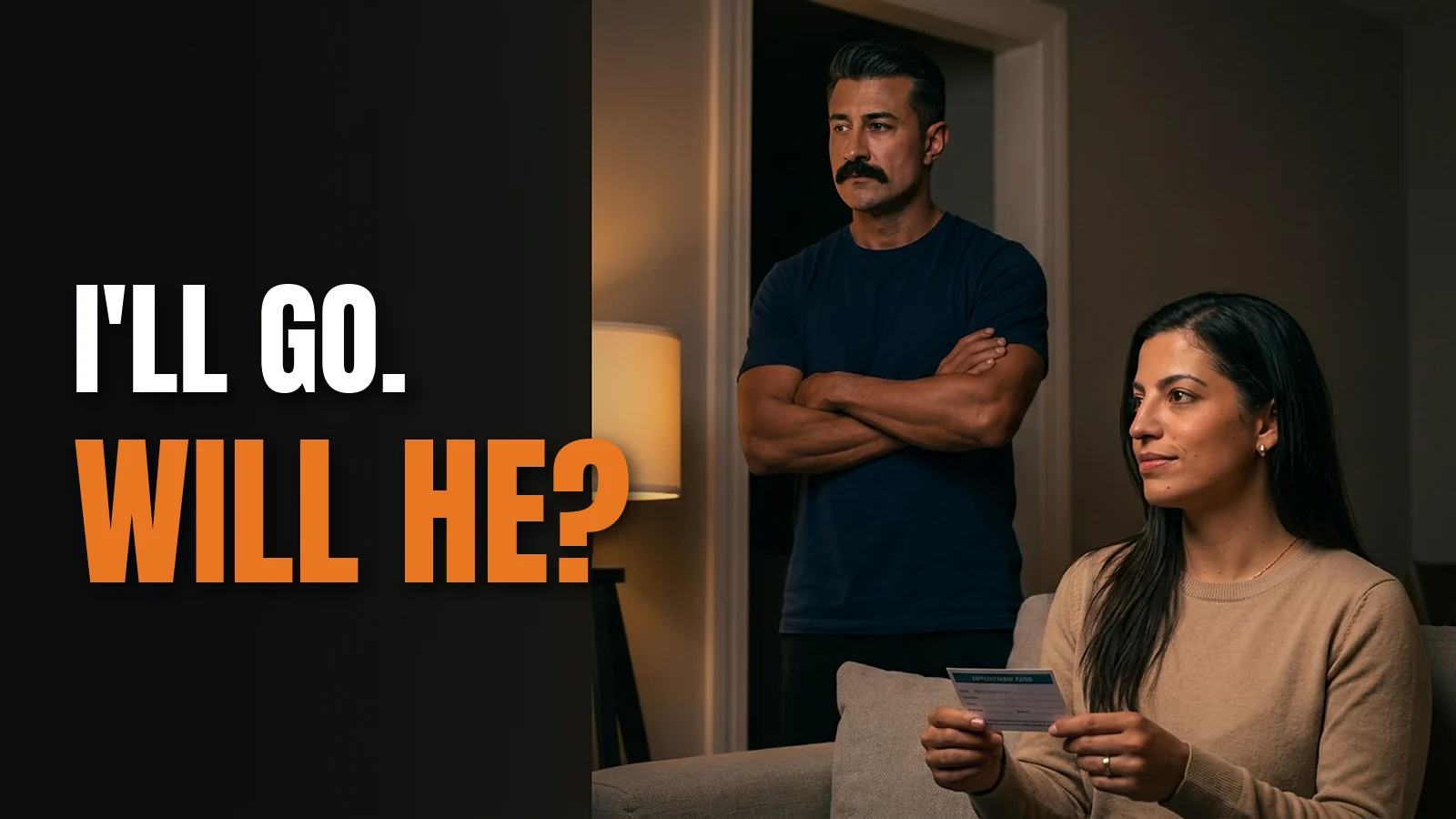
You worked up the courage, picked a calm moment, and said it: “I think we need help. Would you go to counseling with me?” And the answer came back flat. “I don’t need that.” “Counseling is for people who are getting divorced.” “I’m not telling a stranger our business.” Or worse — a silence that closed the subject for good.
If that’s where you are, I know how much it stings. You can see the house is on fire, and the person next to you insists everything is fine. You want to treat the wound; they’d rather pretend it isn’t bleeding. Let’s talk about why this happens, what not to do, and what the path looks like when only one of you wants help.
You’re not the only one
Almost no couple arrives at help at the same time. A study in the Journal of Marital and Family Therapy surveyed 147 married couples who were in the process of seeking therapy and identified three separate steps: recognizing the problem, considering help, and actually seeking it. On average, wives were rated as completing all three steps before their husbands.
That doesn’t mean it’s always the wife who wants help and the husband who digs in his heels — I’ve met plenty of men begging for help while their wives had already shut down. But it does show something important: it’s normal for one spouse to see it first. Being out of sync doesn’t mean your marriage is over. It means you’re at different points on the same road.
There’s good news, too. You’ve probably heard the line that “couples wait six years before getting help, and by then it’s too late.” A more recent study of 270 people who went to couples therapy found something different: the average gap between the start of serious problems and entering therapy was about 2.7 years, and most couples started within two years. The researchers’ conclusion: there’s little reason for pessimism. For most couples, it isn’t too late.
Why your spouse is pushing back
Before you try to persuade, try to understand. The “no” is rarely about counseling. It’s usually about fear.
- Fear of being the bad guy. A lot of people picture a session as a courtroom — two against one.
- Shame. Asking for help feels like admitting failure.
- Pride. Especially for us men. We were raised to believe that handling it alone is what strong guys do.
- A bad experience. A counselor who took sides, a pastor who overshared, a friend who gossiped.
- Fear of what will come out. Sometimes your spouse knows exactly which topic will surface — and isn’t ready.
Scripture is blunt about pride that refuses advice:
“The way of fools seems right to them, but the wise listen to advice.” (Proverbs 12:15, NIV)
But careful: that verse is for you and me first. It’s not a weapon to swing at your spouse. Nobody ever changed because they got called a fool.
What not to do
Don’t use counseling as a threat. “Go with me or I’m leaving” might squeeze out a yes, but a forced yes shows up to the first session with its guard up.
Don’t bring it up mid-fight. Shouting “we need help!” sounds like “you’re broken and need fixing.”
Don’t treat therapy as a way to win the argument. If your real plan is to find someone who’ll finally tell your spouse you were right, they’ll sense it — and they’ll be right to say no.
Don’t go public to apply pressure. Telling your family, your small group, or social media that “he won’t get help” only deepens the shame and hardens the resistance.
How to invite without pressure
Jesus gave us the right order for any hard conversation:
“You hypocrite, first take the plank out of your own eye, and then you will see clearly to remove the speck from your brother’s eye.” (Matthew 7:5, NIV)
In practice, that changes the whole invitation:
- Start with your part. “I’ve noticed I shut down, I criticize, I keep score. I want to learn to do better.” That lowers defenses fast.
- Say “we,” not “you.” “I miss us. I want us to understand each other again.”
- Pick your moment. Not during a fight, not in a rush, not in front of anyone.
- Offer options, not a verdict. A Christian counselor, a trusted pastor, an older couple who could mentor you, a book you read together. Let your spouse help choose.
- Ask for something small. “Just one session. If you hate it, we’ll talk.” Small commitments feel less threatening.
- Take a “not right now” without drama. Sometimes the first no is just the beginning of “maybe.”
“Plans fail for lack of counsel, but with many advisers they succeed.” (Proverbs 15:22, NIV)
Asking for help isn’t failure. It’s biblical wisdom. Plans without counsel fall apart — and your marriage is the biggest plan you’ve got.
What if the answer is still no?
Then go by yourself. Yes, alone.
Many people assume counseling only works with both spouses in the room. It doesn’t. A marriage is like a dance: when one partner changes their steps, the other feels it. You can’t control your spouse’s choices, but you can learn to stop feeding the cycle — the tone, the criticism, the silent treatment, the withdrawal — you’ve been repeating for years.
A few guidelines if you’re going solo:
- Don’t hide it. Calmly say, “I’m going to start talking to someone so I can be a better husband” — or wife. Secrets breed suspicion.
- Don’t use sessions to vent about your spouse. The focus is you: your wounds, your reactions, your walk with God.
- Don’t come home with a diagnosis. “My counselor says you’re a narcissist” will slam the door shut.
- Let the change do the talking. Often the spouse who refused gets curious once they see someone genuinely different at home.
I wrote about the bigger picture in when only one spouse wants to save the marriage. The principle is the same: the battle shifts from convincing your spouse to your own transformation.
One serious caveat: if there’s physical violence, threats, or fear in your home, safety comes first — not couples counseling. Get individual professional help and contact local authorities or a domestic violence hotline. No verse asks you to put yourself in danger.
God works on both sides of the table
“The purposes of a person’s heart are deep waters, but one who has insight draws them out.” (Proverbs 20:5, NIV)
Sometimes your spouse’s refusal hides deep waters even they can’t name: old shame, fear of losing control, pain that was never dealt with. You don’t have to drag it out of them. You can pray, be patient, and build a home where it’s safe to open up.
I was once the problem in my marriage. Vanessa gave God a chance. And trust was rebuilt brick by brick. People don’t change because they’re cornered; they change when they meet grace and truth at the same time. Be the first one to reach for help — not to prove you were right, but so that when your spouse is ready, they’ll find someone on the other side who has already started walking.
If this hit home, Vanessa and I share more about rebuilding marriage on our channels every week.
Sources
- Doss, Atkins & Christensen (2003). Who's dragging their feet? Husbands and wives seeking marital therapy. Journal of Marital and Family Therapy, 29(2), 165–177 — Journal of Marital and Family Therapy (Wiley)
- Doherty, Harris, Hall & Hubbard (2021). How long do people wait before seeking couples therapy? A research note. Journal of Marital and Family Therapy, 47(4), 882–890 — Journal of Marital and Family Therapy (Wiley)
Ricardo Martins
Ricardo Martins is an author, pastor and spokesperson for the Legendários men's movement. With his wife, Vanessa Lima, he created The Legendary Couple (O Casal Legendário), reaching millions with content on Christian marriage and restoration. Author of "Quando o amor recomeça" (Citadel, 2026).
Want to talk with Ricardo & Vanessa?
Follow the daily videos on YouTube and Instagram — real testimony, practical steps, and hope for marriages that look finished.
Watch on YouTubeKeep reading
Reconciliation After Separation: Practical and Spiritual Steps
Getting back together after a separation isn't hitting a reset button. Ricardo Martins shows, from Scripture and research, the practical and spiritual steps of a reconciliation that doesn't rebuild the same marriage that broke.
Read article →
Roommate marriage: when routine quietly kills intimacy
You share a house, a mortgage, and the kids’ calendar, but you no longer share a life. Ricardo Martins explains how routine turns husband and wife into roommates and shows, from Scripture and in practice, the way back to your first love.
Read article →
How to pray for your marriage when you feel nothing
Praying for your marriage with no feeling, no faith and no desire left isn't hypocrisy — it's obedience. Ricardo Martins offers a simple path back, with four short prayers that fit into a real day.
Read article →This content is educational and pastoral. It does not replace therapy, medical, legal or emergency help. If you are in danger, seek help now.