Roommate marriage: when routine quietly kills intimacy
You share a house, a mortgage, and the kids’ calendar, but you no longer share a life. Ricardo Martins explains how routine turns husband and wife into roommates and shows, from Scripture and in practice, the way back to your first love.
 By Ricardo Martins
Published October 2, 2026 · 7 min read
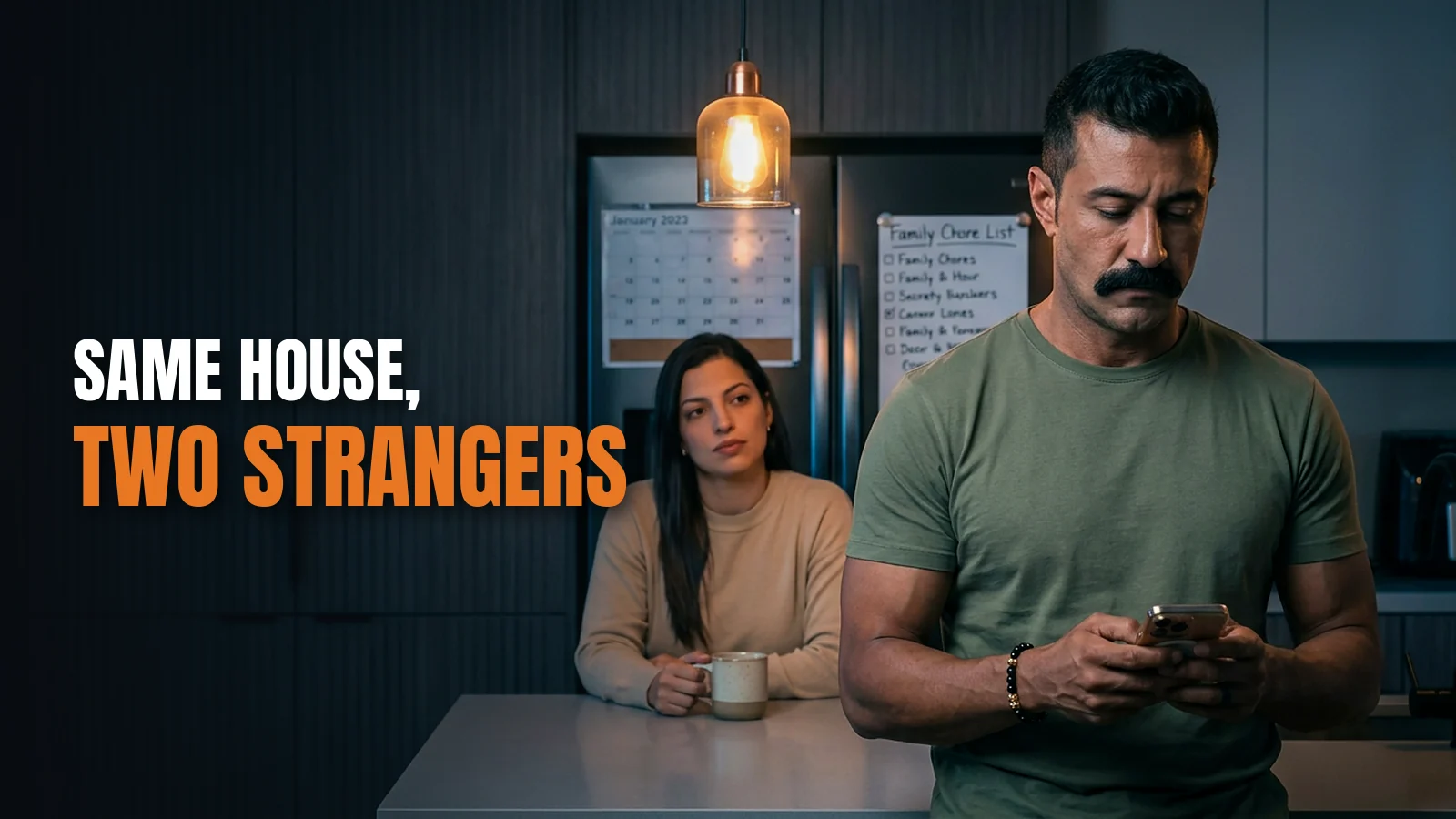
Some couples never fight. No yelling, no slammed doors, no threats to leave. From the outside, everything looks fine. They’ve got a system: who does school pickup, who pays the electric bill, what’s for dinner. The household runs like clockwork.
But once the kids are asleep, everybody grabs a phone. One heads to the couch, the other to bed. The last real conversation was months ago. The last kiss that wasn’t a “bye, see you tonight” peck… nobody can remember.
There’s a name for this: roommate marriage. Two polite, efficient, lonely people under the same roof.
Let me say this up front: it’s not the end. But it’s also not “just what happens after enough years.” It’s a warning light on the dashboard. And warning lights are meant to be taken seriously.
How a couple drifts into roommate mode
Nobody wakes up and decides, “Starting today, I’ll treat my wife like someone who splits the rent with me.” It creeps in, almost without a sound.
First comes the season where everything revolves around kids, work, and bills. Conversation turns into a to-do list. Then comes exhaustion, and exhaustion wants Netflix, not a heart-to-heart. Then comes habit: each of you in your own corner, because it’s easier. And one day you realize you’ve become business partners in a company called Family. Competent partners. But not lovers, not friends, not teammates.
A few signs it’s happening in your home:
- Your conversations are all logistics. Schedules, groceries, school, money. Nothing about dreams, fears, or what God has been showing each of you.
- Touch has disappeared or become a formality. A quick kiss on the way out, a hug on birthdays, and that’s about it.
- You’re more relaxed with other people than with each other. You laugh more with friends and open up more with coworkers.
- You don’t really miss each other. He travels for work, she goes out with friends, and the house actually feels lighter.
- You can’t remember the last time you did something new together. You just repeat.
If two or more of those landed, don’t panic. But stop pretending you don’t see it.
Boredom is a marriage killer too
We tend to think marriages end in big explosions: an affair, an addiction, abuse. Those are devastating. But plenty of marriages die of something far quieter: boredom.
A classic study in the Journal of Personality and Social Psychology (Aron and colleagues, 2000) looked at exactly this. Using a newspaper questionnaire and a door-to-door survey, the researchers found that couples who did “exciting” things together reported higher relationship satisfaction, and that link ran through relationship boredom. Then, in three lab experiments, couples who did a new, challenging task together for just seven minutes reported a bigger increase in relationship quality than couples who did an ordinary, mundane task.
Seven minutes. Not a trip to Paris. Just doing something new, side by side, that knocked them out of autopilot.
The authors connect this to the typical decline in relationship quality after the honeymoon period. In other words, routine isn’t just dull. Over time it drains the bond. The good news is that the road runs the other way too.
What Jesus said to people who forgot their first love
When Jesus writes to the church in Ephesus in the book of Revelation, he praises a lot: their hard work, their perseverance, their doctrinal backbone. It was an efficient church. It ran well. And then comes the line that stings:
“Yet I hold this against you: You have forsaken the love you had at first. Consider how far you have fallen! Repent and do the things you did at first” (Revelation 2:4-5, NIV).
Notice Jesus doesn’t say, “Someone stole your first love.” He says you forsook it. You set it down and walked away. And the remedy he gives has three very practical steps that apply to our walk with God and to marriage alike:
- Remember. Go back. What was it like when you first met? What did you do for her? What did he do for you?
- Repent. Own your part without pointing fingers. Not “we drifted apart,” but “I stopped pursuing you.”
- Do the things you did at first. He doesn’t say “feel what you used to feel.” He says do. In my experience, feelings usually follow obedience, not the other way around.
Remember Martha and Mary? Martha was busy, serving, doing everything right. And Jesus told her, “Martha, Martha, you are worried and upset about many things, but few things are needed—or indeed only one” (Luke 10:41-42, NIV). A lot of couples are living in Martha mode: doing everything except the one thing that matters, which is actually being present with each other.
God takes a couple’s joy seriously
Some people think enjoying your spouse is a luxury, something for newlyweds. Scripture treats it as serious business.
Under the law of Moses, a newly married man was exempt from military duty for a year so he could “stay at home and bring happiness to the wife he has married” (Deuteronomy 24:5, NIV). God literally cleared a nation’s calendar so couples could build joy.
And the Teacher in Ecclesiastes, after surveying all the hustle under the sun, says: “Enjoy life with your wife, whom you love, all the days of this meaningless life” (Ecclesiastes 9:9, NIV). Not “tolerate.” Enjoy.
In the Song of Songs, the beloved calls his bride out of the routine: “Arise, my darling, my beautiful one, come with me” (Song of Songs 2:10, NIV). Biblical love takes initiative. Somebody has to get up and invite the other.
How to move out of roommate mode
There’s no magic formula, and I won’t promise everything will be back in a week. But there are concrete steps I’ve seen work for couples who decide to come back to each other:
- Have an honest conversation without blame. Something like: “I miss us. I don’t want us to just be business partners. Will you try with me?” Talk about you, not about what your spouse failed to do.
- Protect 15 screen-free minutes a day. Phones in another room, TV off. One question: “How was your day, really?” And listen all the way to the end.
- Start dating again, on the calendar. Once a week or every other week, even if it’s just coffee at the corner shop. Put it in your calendar like any other commitment, because it is one.
- Try something new together. A hike, a new recipe, a dance class, a different route home. Remember those seven minutes? Shared novelty pulls you closer.
- Bring back non-sexual touch. Holding hands in the car, a long hug in the kitchen, a hand on the shoulder. Your body has to relearn that your spouse is a safe place.
- Pray together. Short, simple, holding hands. It’s hard to stay a stranger to someone you talk to God with every day.
- If there’s buried hurt, deal with it. Sometimes the distance isn’t just routine. It’s an unhealed wound. That’s when it’s worth reaching out to a pastor or a Christian counselor.
For the one lying awake on the other side of the bed
If you’re reading this and thinking, “But I’ve tried, and my spouse isn’t interested,” I get it. Starting alone hurts. But somebody always has to take the first step.
I was once the problem in my own marriage. And Vanessa gave God a chance. Our home wasn’t rebuilt overnight: trust came back brick by brick. That’s why I don’t believe in hopeless marriages. I believe in marriages that stopped investing and can start investing again.
You don’t have to rekindle everything tonight. You just have to stop accepting distance as if it were destiny. Remember. Repent. Do the things you did at first. Tonight, put your phone away and ask how her day really went. Or his.
If you want more honest, faith-filled encouragement for your marriage, Vanessa and I share it every week on our channels.
Sources
- Aron, Norman, Aron, McKenna & Heyman (2000). Couples’ shared participation in novel and arousing activities and experienced relationship quality. Journal of Personality and Social Psychology, 78(2), 273–284 — Journal of Personality and Social Psychology (APA) / PubMed 10707334
Ricardo Martins
Ricardo Martins is an author, pastor and spokesperson for the Legendários men's movement. With his wife, Vanessa Lima, he created The Legendary Couple (O Casal Legendário), reaching millions with content on Christian marriage and restoration. Author of "Quando o amor recomeça" (Citadel, 2026).
Want to talk with Ricardo & Vanessa?
Follow the daily videos on YouTube and Instagram — real testimony, practical steps, and hope for marriages that look finished.
Watch on YouTubeKeep reading

Sex in Christian marriage: what the church doesn't teach
For years the church said "wait" and rarely explained what happens after the wedding. Ricardo Martins talks — pastorally, without being crude — about what the Bible actually says about intimacy in marriage.
Read article →
How to pray for your marriage when you feel nothing
Praying for your marriage with no feeling, no faith and no desire left isn't hypocrisy — it's obedience. Ricardo Martins offers a simple path back, with four short prayers that fit into a real day.
Read article →
Marriage after burnout: when a husband breaks on the inside
Burnout doesn't just wreck a man's career, it empties his home. Ricardo Martins, who has been through burnout himself, speaks to the exhausted husband and to the wife living beside him about what to do when a man breaks on the inside.
Read article →This content is educational and pastoral. It does not replace therapy, medical, legal or emergency help. If you are in danger, seek help now.