How to apologize for real (it’s not “sorry if I hurt you”)
“I’m sorry if I hurt you” isn’t an apology — it’s a way to end the conversation. Ricardo Martins shows, from Scripture and research, what separates a real apology from an empty one in marriage.
 By Ricardo Martins
Published October 3, 2026 · 8 min read
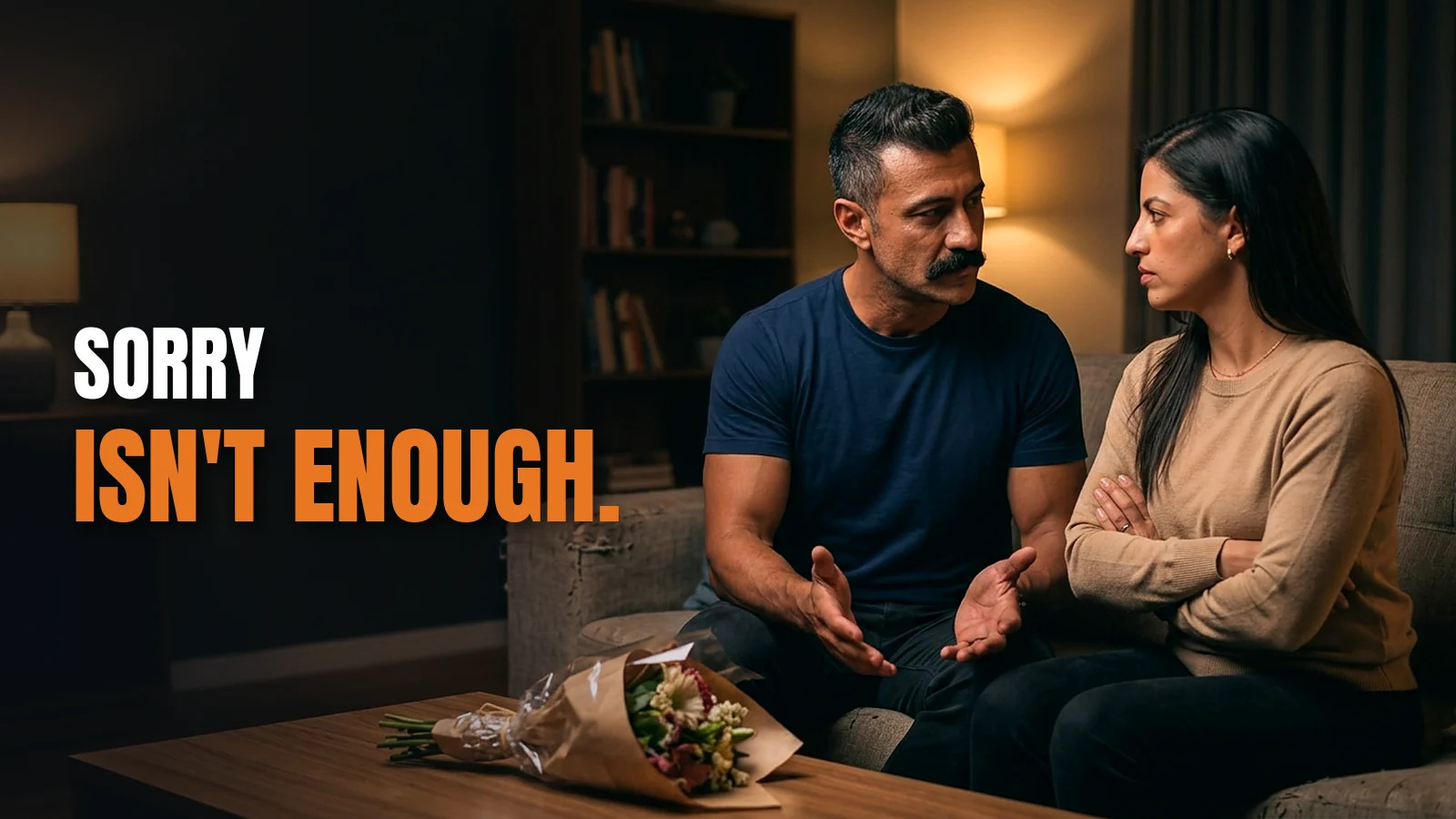
You’ve heard it. Maybe you’ve said it: “I’m sorry if I hurt you.”
It sounds like an apology. It has the word “sorry” in it, and a softer voice. But the person on the receiving end knows, deep down, that something’s missing. Because that sentence isn’t asking for forgiveness. It’s asking for the conversation to be over.
That little word “if” changes everything. “If I hurt you” really means: “I’m not convinced I did anything wrong; maybe the problem is that you’re too sensitive.” It’s an apology that hands the blame right back to the person who got hurt.
I want to be straight with you about this, because most marriages don’t die from one massive mistake. They die from hundreds of small ones that were never truly repaired. A wound that’s never dealt with becomes a scar that never quite closes. And scars that don’t close get infected.
The oldest excuse in the book
The very first conversation after the very first sin was already a bad apology. God asks Adam what happened, and he answers:
“The woman you put here with me—she gave me some fruit from the tree, and I ate it.” (Genesis 3:12, NIV)
Notice what he does. Adam admits the fact (“I ate it”), but puts two people in front of himself — the woman, and God (“you put here with me”). Since Eden, the human heart has had the same reflex: confess as little as possible, blame as much as possible.
In marriage, it sounds like this:
- “I’m sorry, but you also…”
- “I’m sorry if you took it the wrong way.”
- “Fine, I’m sorry. Happy now?”
- “I apologize, it’s just that I was exhausted.”
- “I already said I’m sorry — what else do you want from me?”
Every one of those has the right word and the wrong heart. “But” erases everything that came before it. “If” turns a wound into a question mark. And “what else do you want” turns an apology into a demand.
What research found about apologies
In 2016, researchers at The Ohio State University, led by Roy Lewicki, published a study on what makes an apology effective. Across two experiments with 755 participants, they tested six elements (Lewicki, Polin & Lount, 2016):
- Expressing regret (“I’m sorry”).
- Explaining what went wrong.
- Acknowledging responsibility (“it was my fault”).
- Declaring repentance (“it won’t happen again”).
- Offering to repair (“how can I make this right?”).
- Asking for forgiveness.
The more elements an apology included, the more effective it was rated. But the single most important one was acknowledging responsibility. Second was offering to repair. And the least effective on its own? The “will you forgive me?” (Ohio State News, 2016).
An honest caveat: the scenario in that study was a workplace one, not a marriage. But it confirms something Scripture has taught for thousands of years. Saying sorry without owning it is just ceremony. And “please forgive me” with no willingness to fix anything sounds like you’re in a hurry to move on.
One more finding worth noticing: apologies after integrity violations — lying, breaking trust — were seen as less effective than apologies after competence mistakes. Translate that into marriage: when the wound is about character, words won’t cut it. It’s going to take time and action.
Two kings, two “I have sinned”
The Bible shows us two kings of Israel saying the exact same words — “I have sinned” — with opposite hearts.
Saul, confronted by the prophet Samuel, says:
“I have sinned. I violated the LORD’s command and your instructions. I was afraid of the men and so I gave in to them.” (1 Samuel 15:24, NIV)
He confesses, then immediately explains: the pressure from the people made him do it. A few verses later he asks Samuel to “honor me before the elders of my people and before Israel” (1 Samuel 15:30, NIV). Saul’s apology was about Saul’s image.
David, confronted by the prophet Nathan after his adultery with Bathsheba, answers:
“I have sinned against the LORD.” (2 Samuel 12:13, NIV)
No “but,” no “if,” no explanation to protect himself. Psalm 51 shows the rest of that brokenness. David still faced heavy consequences — forgiveness doesn’t erase consequences — but his heart was turned toward God, not toward his reputation.
So here’s my question for you: when you apologize to your spouse, are you more concerned about their pain or about your image?
How to apologize for real
Putting Scripture and plain wisdom together, a real apology looks like this:
1. Name what you did — without softening it. Not “that thing from last night.” Say it: “I yelled at you in front of the kids.” The prodigal son didn’t say “some stuff happened.” He said: “Father, I have sinned against heaven and against you” (Luke 15:18, NIV).
2. Own all of it. Even if your spouse was wrong too, your part is yours. There may be a separate conversation about their part — but not now, and not stapled to your apology.
3. Acknowledge the hurt you caused. “I know that humiliated you.” That’s not being dramatic; it shows you actually saw the person, not just your mistake.
4. Offer to make it right. Zacchaeus didn’t stop at “I feel bad.” He said: “If I have cheated anybody out of anything, I will pay back four times the amount” (Luke 19:8, NIV). Ask: “What can I do to make this right?” Then actually listen.
5. Say what’s going to change — and change it. In the Bible, repentance means turning around. If today’s apology sounds exactly like last month’s, for the exact same thing, your spouse doesn’t need better words. They need a different husband or wife.
6. Ask for forgiveness — don’t demand it. “Will you forgive me?” is a question, not an order. Forgiveness is the decision of the one who was hurt, and sometimes it takes time. Pressuring your spouse to forgive fast is just one more way of keeping yourself at the center.
When the wound runs deep
Some mistakes get resolved in one honest conversation. Others shatter trust — repeated lies, an affair, a hidden addiction. In those cases, the apology is the beginning, not the finish line. I wrote about the other side of this in can you really forgive an affair?: forgiveness is a decision, but trust has to be rebuilt.
I was once the problem in my own marriage. Vanessa gave God a chance. And trust was rebuilt brick by brick. That’s why I’m telling you: with wounds like these, no well-crafted apology does it alone. What rebuilds is repentance that turns into action, day after day, without putting a deadline on the person you hurt.
If that’s where you are, get help: a mature pastor, a Christian counselor, a licensed marriage therapist. Asking for help isn’t weakness.
Reconciliation before the altar
Jesus said something that should shake every married Christian:
“Therefore, if you are offering your gift at the altar and there remember that your brother or sister has something against you, leave your gift there in front of the altar. First go and be reconciled to them; then come and offer your gift.” (Matthew 5:23-24, NIV)
God is in no rush to receive your Sunday worship if you owe someone an apology at home. There are men who raise their hands in church but can’t say “I was wrong” to their own wife. There are women who serve in three ministries and have been giving their husband the silent treatment for months.
James finishes the thought: “Therefore confess your sins to each other and pray for each other so that you may be healed” (James 5:16, NIV). Honest confession makes room for healing. Pride keeps the wound open.
A real apology costs something. It costs your pride, your need to be right, your urge to win the argument. But that’s exactly the road Christ walked for us: He paid the price for a reconciliation we could never afford. People who’ve been forgiven like that learn to apologize without “if” and without “but.”
So start today with one simple sentence, with nothing after it: “I was wrong. Will you forgive me?” And if your arguments always seem to end badly, read fighting fair: biblical rules for conflict next.
Sources
- Lewicki, Polin & Lount (2016). An Exploration of the Structure of Effective Apologies. Negotiation and Conflict Management Research, 9(2), 177–196 — Negotiation and Conflict Management Research (Wiley)
- The 6 elements of an effective apology, according to science — The Ohio State University News
Ricardo Martins
Ricardo Martins is an author, pastor and spokesperson for the Legendários men's movement. With his wife, Vanessa Lima, he created The Legendary Couple (O Casal Legendário), reaching millions with content on Christian marriage and restoration. Author of "Quando o amor recomeça" (Citadel, 2026).
Want to talk with Ricardo & Vanessa?
Follow the daily videos on YouTube and Instagram — real testimony, practical steps, and hope for marriages that look finished.
Watch on YouTubeKeep reading

Fighting fair: biblical rules for conflict in marriage
A healthy marriage isn't a marriage without fights — it's a marriage that knows how to fight. Ricardo Martins shares seven biblical rules for arguing without destroying each other, and how to come back when it goes too far.
Read article →
Roommate marriage: when routine quietly kills intimacy
You share a house, a mortgage, and the kids’ calendar, but you no longer share a life. Ricardo Martins explains how routine turns husband and wife into roommates and shows, from Scripture and in practice, the way back to your first love.
Read article →
Marriage after burnout: when a husband breaks on the inside
Burnout doesn't just wreck a man's career, it empties his home. Ricardo Martins, who has been through burnout himself, speaks to the exhausted husband and to the wife living beside him about what to do when a man breaks on the inside.
Read article →This content is educational and pastoral. It does not replace therapy, medical, legal or emergency help. If you are in danger, seek help now.