Gottman's Four Horsemen: What 15 Minutes of Conflict Reveal About a Marriage
What John Gottman and Robert Levenson's research actually found about criticism, contempt, defensiveness, and stonewalling — sample sizes, numbers, and limits — and what it changes for Christian couples.
 By Ricardo Martins
Published September 23, 2026 · 7 min read
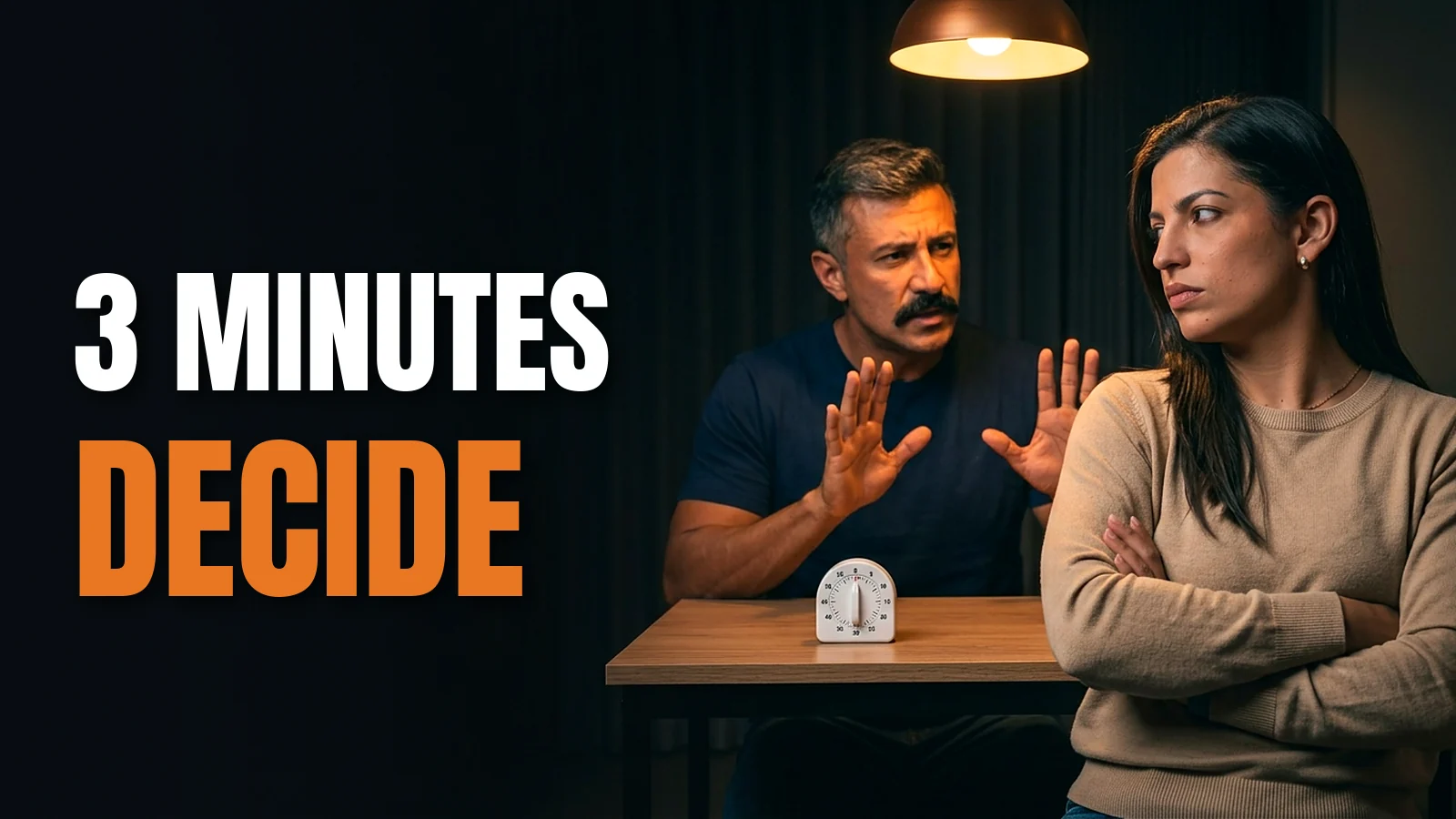
“We always fight the same way. It starts small, somebody uses the wrong tone, and five minutes later it feels like we hate each other. Does that mean our marriage is doomed?”
I hear some version of that question all the time — from couples in Brazil and from couples here in the United States. And I understand the fear underneath it. When the same fight replays for months, it starts to feel like the ending is already written and you’re just waiting for the date.
I used to be the problem in my own marriage. I know what it’s like to live in a house where every conversation feels like a minefield. I also know that Vanessa gave God a chance, and that trust was rebuilt brick by brick. So I don’t approach this topic with fatalism. But I don’t want to approach it with guesswork either. Today I want to show you what serious research found about how couples fight — because that tells you far more than how often they fight.
What the research found
The “Four Horsemen” — criticism, contempt, defensiveness, and stonewalling — is the popular label psychologist John Gottman used in his books for patterns he and his colleague Robert Levenson measured in the lab for decades. In the peer-reviewed papers, those patterns show up under more technical names. Let’s go study by study.
1. Gottman & Levenson (1992), Journal of Personality and Social Psychology. Researchers at the University of Washington studied 73 married couples in 1983 and followed up in 1987. They recorded conversations, measured physiological responses, and coded every expression. Couples whose interactions tilted toward the negative (they called them “nonregulated”) showed, compared with the others: more defensiveness, more stubbornness and withdrawal from the interaction, more negative and less positive emotion, poorer health four years later, and a higher risk of dissolution — more serious thoughts of separating and more actual separations. The paper also proposed a “cascade”: unhappiness leads to considering separation, which leads to separation, which leads to divorce.
2. Carrère & Gottman (1999), Family Process. This is where the famous “first few minutes” come from. The team coded a real conflict discussion from 124 newlywed couples and split each 15-minute conversation into five 3-minute blocks. The finding: they could predict marital outcomes over six years using only the first three minutes of data, for both husbands and wives. In other words, the way a hard conversation starts already carries a lot of the way the marriage is going.
3. Gottman & Levenson (2000), Journal of Marriage and Family. The long one: couples followed for 14 years (the full sample was 79 couples, 21 of whom divorced during the study, per the companion 2002 paper in Family Process). The researchers analyzed two conversations — one about a conflict, and one “how was your day” talk after the spouses had been apart for at least eight hours. The most striking result: negative emotion during conflict predicted early divorce, but not later divorce. The absence of positive emotion — in conflict and in ordinary end-of-day conversation — predicted later divorce. A model combining marital satisfaction, thoughts of divorce, and the emotional tone of both conversations classified 93% of cases correctly.
4. Kiecolt-Glaser and colleagues (2005), Archives of General Psychiatry (Ohio State University). This one moves from the marriage to the body. 42 healthy married couples were admitted twice to a hospital research unit for 24 hours. They received small, controlled blister wounds; on one visit they had a supportive conversation, on the other they discussed a marital disagreement. Wounds healed more slowly after conflict. Couples who showed consistently high levels of hostility healed at 60% of the rate of low-hostility couples, and showed bigger jumps in inflammatory markers the morning after a fight.
The limits — and they matter
It would be dishonest to stop at the numbers. So here are the caveats:
- Correlation is not causation. These studies show that certain patterns travel with divorce and poorer health. They don’t prove that one contemptuous comment “causes” a marriage to end.
- Small, specific samples. 42, 73, 79, 124 couples — almost all American, mostly in the Seattle area. We don’t know exactly how these numbers hold across other cultures, faith communities, or income levels.
- The 93% is not a crystal ball. That figure comes from a model fitted to the same sample it describes. Applied to brand-new couples, accuracy would likely be lower. No researcher can look at your marriage and name an end date.
- The Four Horsemen are a synthesis. The label comes from Gottman’s popular books summarizing many studies. The papers measure specific behaviors — defensiveness, withdrawal, hostility, negative and positive affect — not an “official list.”
What we can say with confidence is this: the way you talk during conflict — and on an ordinary Tuesday — is one of the most consistent signals researchers have measured about where a marriage is heading. And the way you talk can change.
What this changes in practice
1. Guard the first three minutes. If the opening matters that much, the opening is where you have the most leverage. Swap “You never help me” for “I’m exhausted and I need help with the kids tonight.” Talk about what you feel and what you need, not about your spouse’s character flaws. That disarms criticism before it’s born.
2. Declare war on contempt. Eye-rolling, sarcasm, mocking nicknames, a superior tone. Contempt says, “I’m better than you.” The antidote is a daily habit of appreciation: every day, tell your spouse one specific thing you admire or are grateful for. Not flattery — training your eyes to see.
3. Own your part. Defensiveness says, “The problem is you.” Try starting your reply with “You’re right about this part…” or “That piece is on me.” You don’t have to take 100% of the blame; just stop defending 100% of your innocence.
4. Take a break — and come back. Stonewalling — going silent, leaving the room, disappearing into your phone — is often a flooded nervous system. Pausing is legitimate; vanishing is not. Agree on a signal (“I need a break, I’ll be back in thirty minutes”) and actually come back to the conversation.
5. Invest in “How was your day?” The 14-year study found that a lack of positive in everyday conversation predicted later divorce. Marriages don’t only die from fighting; they also die from cold reunions at the end of the day. Ten screen-free minutes of real conversation after work is prevention.
Where the Bible already said this
Long before any lab in Seattle, Solomon wrote: “The words of the reckless pierce like swords, but the tongue of the wise brings healing” (Proverbs 12:18, NIV). Words wound, words heal. Researchers measured that in heart rates, skin wounds, and years of marriage.
Paul was even more direct about what should come out of our mouths: “Do not let any unwholesome talk come out of your mouths, but only what is helpful for building others up according to their needs, that it may benefit those who listen” (Ephesians 4:29, NIV). Building up is the exact opposite of criticism and contempt.
And Proverbs 17:22 reminds us that “a cheerful heart is good medicine, but a crushed spirit dries up the bones” (NIV). That’s not a promise of healing, and no verse replaces a doctor or a counselor. But it is wisdom that today’s research echoes in different words: the emotional climate of a home affects the whole body.
Closing
If you recognized yourselves in one of the Horsemen, take a breath. This is not a verdict. The same studies that describe the risk also point to the way out: how you start hard conversations, daily appreciation, owning your part, coming back after the break, and refusing to let the end of the day turn into silence. That’s how God rebuilt, brick by brick, what I myself had torn down.
For more honest conversations about marriage and faith, Vanessa and I share every week on our YouTube channel and Instagram.
Sources
- Gottman & Levenson (1992). Marital processes predictive of later dissolution: behavior, physiology, and health. Journal of Personality and Social Psychology, 63(2), 221–233 — APA / PubMed 1403613
- Carrère & Gottman (1999). Predicting divorce among newlyweds from the first three minutes of a marital conflict discussion. Family Process, 38(3), 293–301 — Family Process / PubMed 10526767
- Gottman & Levenson (2000). The timing of divorce: predicting when a couple will divorce over a 14-year period. Journal of Marriage and Family, 62(3), 737–745 — Journal of Marriage and Family
- Gottman & Levenson (2002). A two-factor model for predicting when a couple will divorce: exploratory analyses using 14-year longitudinal data. Family Process, 41(1) — Family Process
- Kiecolt-Glaser et al. (2005). Hostile marital interactions, proinflammatory cytokine production, and wound healing. Archives of General Psychiatry, 62(12), 1377–1384 — Archives of General Psychiatry / PubMed 16330726
Ricardo Martins
Ricardo Martins is an author, pastor and spokesperson for the Legendários men's movement. With his wife, Vanessa Lima, he created The Legendary Couple (O Casal Legendário), reaching millions with content on Christian marriage and restoration. Author of "Quando o amor recomeça" (Citadel, 2026).
Want to talk with Ricardo & Vanessa?
Follow the daily videos on YouTube and Instagram — real testimony, practical steps, and hope for marriages that look finished.
Watch on YouTubeKeep reading

Fighting fair: biblical rules for conflict in marriage
A healthy marriage isn't a marriage without fights — it's a marriage that knows how to fight. Ricardo Martins shares seven biblical rules for arguing without destroying each other, and how to come back when it goes too far.
Read article →
Marriage in crisis: the 5 silent signs before a separation
Almost no separation actually starts on the day of the separation. Ricardo Martins walks through the five silent signs that show up months earlier — and one practical move for each, this week.
Read article →
Indifference kills more marriages than affairs do
Most marriages don't end with a scandal — they end with an "I'm fine" repeated for years. Ricardo Martins on what John Gottman's research reveals and what to do about it today.
Read article →This content is educational and pastoral. It does not replace therapy, medical, legal or emergency help. If you are in danger, seek help now.