Girls Do Almost 4 More Hours of Chores a Week Than Boys: Your Son's Marriage Starts at Your Kitchen Sink
A Federal University of Uberlândia (UFU) study using Brazil's 2023 national household survey, reported by g1 on November 13, 2026, finds 17-year-old girls spend nearly four more hours a week on housework than boys, with the gap starting at age 8. Ricardo Martins comments on what this means for tomorrow's marriages.
 By Ricardo Martins
Published November 13, 2026 · 6 min read
The news
On Friday, November 13, Brazil’s news site g1 reported on research by economist Maria Carolina do Amaral Couto of the Federal University of Uberlândia (UFU), based on Brazil’s 2023 national household survey (PNAD Contínua) from the national statistics agency, IBGE. The finding: by age 17, Brazilian girls spend almost four more hours a week on housework than boys the same age, and the gap starts showing up at age 8.
Among 16- and 17-year-olds, more than 75% of girls cook and wash dishes, compared with about 50% of boys. For washing clothes and shoes, it’s 66% versus 44%. Boys come out ahead only in small home repairs. According to the researcher, the gap holds even after accounting for income, race and where families live.
Two honest caveats. First, I read the g1 coverage and the IBGE data, not the full paper; the study, titled Who Cares From Early On?, won first place in the Corecon-MG Women Economists in Science Award. Second, this is Brazilian data, and American homes may look different. Still, the base is solid: 2023 was the first time the survey asked about housework and caregiving by kids aged 5 to 17, and IBGE had already reported that 52.6% of them, about 20.1 million children and teens, did that kind of work that year.
What follows is my opinion, as someone who walks alongside couples in crisis.
This isn’t about dishes. It’s about tomorrow’s marriages
When a couple tells me, “We fight over silly things,” the silly thing often has a name: dishes, laundry, who gets up at night, who remembers the pediatrician appointment. It’s not silly. It’s the feeling of carrying the whole house alone.
This study confirms something I already suspected: that feeling isn’t born in marriage. It’s taught long before. An 8-year-old girl who gets called into the kitchen while her brother goes off to play learns a lesson without anyone saying a word: taking care of the home is your job. Her brother learns the opposite lesson: someone will take care of it for me.
Twenty years later, they both marry other people. And they carry those lessons into their homes.
Scripture says, “Start children off on the way they should go, and even when they are old they will not turn from it” (Proverbs 22:6, NIV). We usually read that verse about faith and values, and rightly so. But the way is also made of small habits. Who washes the plate after dinner is a habit. And childhood habits become marriage expectations.
Chores aren’t punishment. They’re discipleship
Let me be clear: the problem isn’t girls helping. Kids who help at home learn responsibility, learn that the home belongs to everyone, learn to serve. That’s good. The problem is when the math doesn’t add up: one part of the family learning to serve and another learning to be served.
On the night of the Last Supper, Jesus took a towel and a basin and washed His disciples’ feet. Then He said, “Now that I, your Lord and Teacher, have washed your feet, you also should wash one another’s feet. I have set you an example that you should do as I have done for you” (John 13:14-15, NIV).
The Lord and Teacher did the lowliest job in the house. If our sons grow up thinking the sink, the broom and the laundry are “girl stuff,” they haven’t just learned an unfair division of labor. They’ve learned a Christianity without a towel. And a husband without a towel will struggle to understand Ephesians 5, which calls husbands to love their wives “just as Christ loved the church and gave himself up for her” (Ephesians 5:25, NIV).
“For even the Son of Man did not come to be served, but to serve” (Mark 10:45, NIV). That sentence needs to leave the pulpit and reach the laundry room.
A word to us men
I say this humbly, because I was once the problem in my own marriage. I worked 16 hours a day and called it taking care of my family. It was my golden calf. It was at Legendários, the international men’s movement, that God opened my eyes to how much I was throwing my home away.
Today I understand that leading a home isn’t sitting at the head of the table. It’s being the first to get up and clear the plates. Dad, your son won’t learn to serve his future wife by hearing a sermon. He’ll learn by watching you at the sink, sleeves rolled up, without treating it like a favor.
And don’t call it “helping your wife.” Nobody “helps” in their own home. We do our part. “Carry each other’s burdens, and in this way you will fulfill the law of Christ” (Galatians 6:2, NIV).
A word to moms
Many moms, without realizing it, repeat what they lived. They ask their daughter because she “does it better,” because it’s faster, because the boy “isn’t good at it.” I understand the exhaustion. But a boy only gets good at it if he’s given room to get it wrong. Teaching takes longer than doing. It’s worth it.
The study also notes that Black, mixed-race, Indigenous and rural girls in Brazil carry the heaviest load, often because their families have no one to share the caregiving with. This isn’t the moment to point fingers at people who are just surviving. It’s the moment for the church to ask: who in our community is raising kids alone and needs an extra pair of hands?
For the two of you
Tonight, after dinner, look at your household routine together and ask:
- If our kids copied exactly the division of chores they see between us, what kind of marriage would they have?
- What chore can each child, boy or girl, learn this week, appropriate to their age?
- Is there a load one of us carries quietly that the other doesn’t even notice?
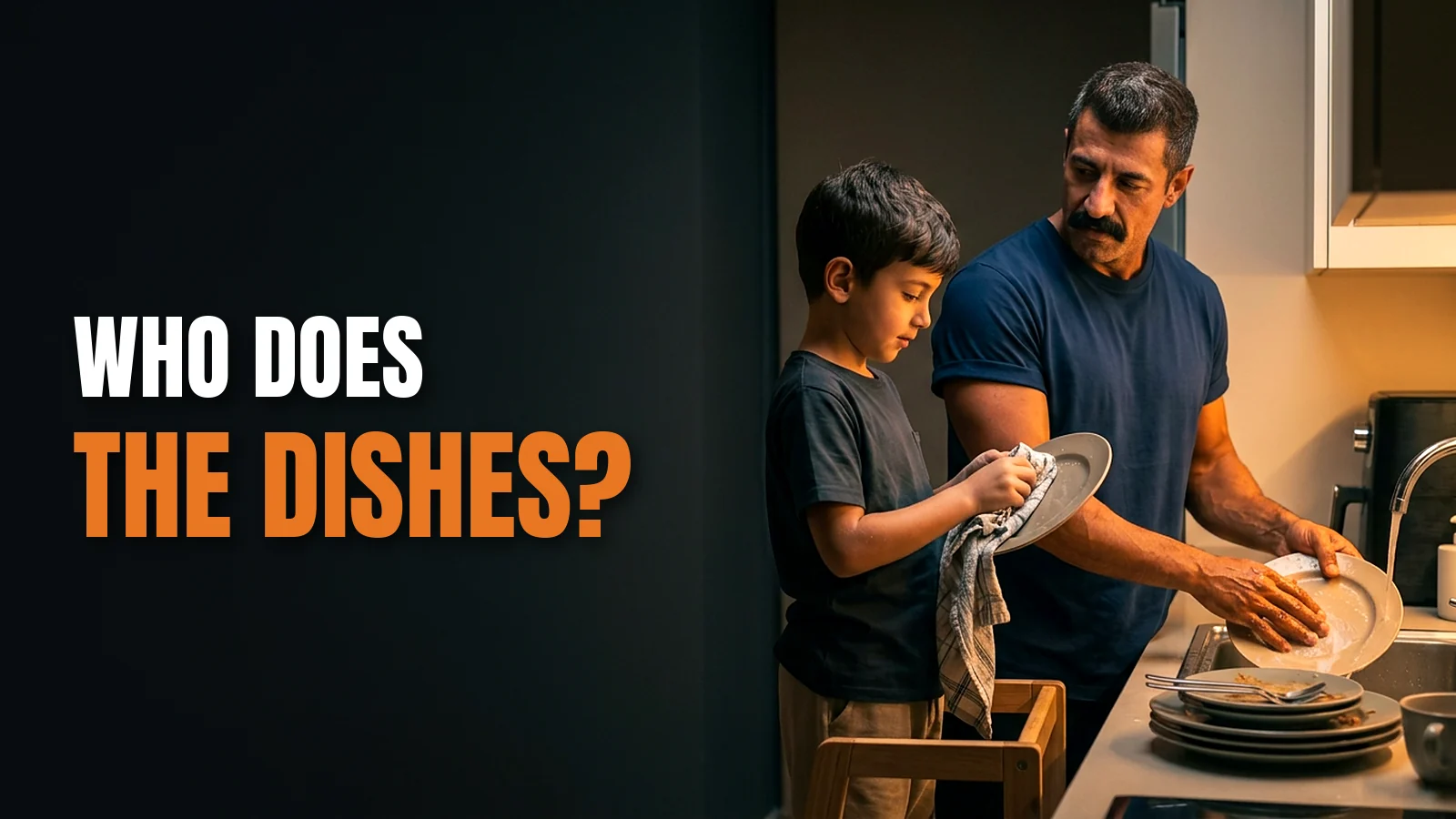
Start small. One night of dishes, father and son side by side, is a whole sermon.
If you want more conversations like this, Vanessa Lima and I share them every week on our YouTube channel and on Instagram at @ocasallegendario.
Sources
- Meninas dedicam quase 4 horas a mais por semana às tarefas domésticas do que meninos, aponta pesquisa em MG (in Portuguese) — g1 (Globo), Nov. 13, 2026
- Em 2023, trabalho infantil volta a cair e chega ao menor nível da série (PNAD Contínua: housework and care by children aged 5–17, in Portuguese) — IBGE, Brazilian Institute of Geography and Statistics (primary data)
- Seminário Mulher Economista de Minas Gerais (award announcement, in Portuguese) — Corecon-MG
Ricardo Martins
Ricardo Martins is an author, pastor and spokesperson for the Legendários men's movement. With his wife, Vanessa Lima, he created The Legendary Couple (O Casal Legendário), reaching millions with content on Christian marriage and restoration. Author of "Quando o amor recomeça" (Citadel, 2026).
Want to talk with Ricardo & Vanessa?
Follow the daily videos on YouTube and Instagram — real testimony, practical steps, and hope for marriages that look finished.
Watch on YouTubeKeep reading

Brazil's Adoption Line: 94% Want a Child Under 8, but 7 in 10 Waiting Kids Are Older
Data from Brazil's National Adoption and Foster Care System (SNA), run by the National Council of Justice (CNJ) and reported by O Globo on November 15, 2026, show more approved families than children available for adoption, yet the profiles don't match. Ricardo Martins comments on what this reveals about family, grace and the Christian couple's heart.
Read article →
“No Kids Allowed”: Brazil's Childfree Spaces and What They Say About Us
A Folha de S.Paulo report (Oct. 11, 2026) shows the rise of childfree spaces in Brazil — bars, hotels, inns and even adults-only weddings — a practice Brazil's consumer-rights institute Idec calls abusive. Ricardo Martins comments on what it reveals about how our culture sees children, and what couples and churches can do.
Read article →
28% of Brazilians would reject their child's marriage over politics. The election is over — what about your dinner table?
A Quaest poll released on November 9 shows family breakups over politics in Brazil fell from 36% to 10% in three years — but 28% would still disapprove of a son or daughter marrying someone from the opposing political camp. Ricardo Martins comments, without taking sides, on what that reveals about our homes.
Read article →This content is educational and pastoral. It does not replace therapy, medical, legal or emergency help. If you are in danger, seek help now.