How Often Is Enough? What the Research Says About Sex and Marital Satisfaction
What five peer-reviewed studies — more than 30,000 people, 26,000 survey respondents, and couples followed for up to 14 years — actually found about sexual frequency, affection, and marital satisfaction, with the numbers, the limits, and what it means for Christian couples.
 By Ricardo Martins
Published October 1, 2026 · 7 min read
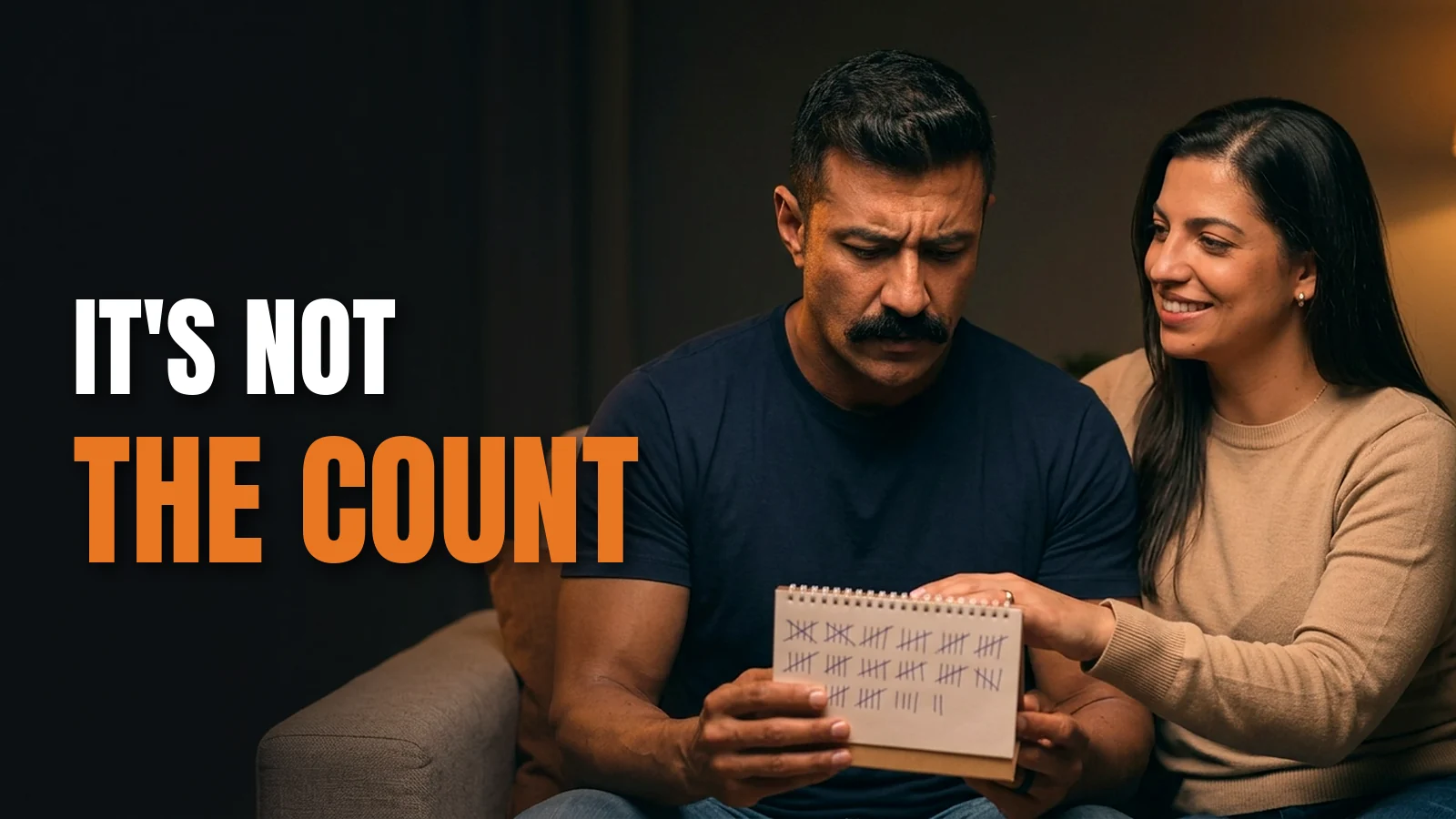
“Ricardo, we barely have any intimacy anymore. Is our marriage dying?” And right behind it, the question almost nobody asks out loud: “How often is normal?”
I hear both questions a lot. Usually the person asking doesn’t want a biology lecture. They want to know if they’re okay — whether their spouse still wants them, whether the distance in the bedroom is a symptom of a bigger distance. And very often one of the two is keeping score. The score turns into pressure, and the pressure turns into more distance.
I used to be the problem in my own marriage, so I don’t treat intimacy with formulas or guesswork. But honest numbers can take the weight off some myths. So today I want to show you what serious, peer-reviewed research has found about sexual frequency and marital satisfaction. Spoiler: “how often?” turns out to be the least important question on the list.
What the research found
1. Muise, Schimmack & Impett (2016), Social Psychological and Personality Science (University of Toronto). This is the most-cited study on the topic. It combined three studies with a total of 30,645 people in the United States. In the first, the link between sexual frequency and well-being showed up only for people in relationships. In the other two — partnered people only — frequency had a curvilinear relationship with relationship satisfaction: it rises up to about once a week, and beyond that it is no longer significantly associated with well-being. In other words, more than that showed no measurable extra benefit. And the path ran through the relationship itself: relationship satisfaction explained the link between sex and well-being.
2. Twenge, Sherman & Wells (2017), Archives of Sexual Behavior. Using the General Social Survey — a nationally representative U.S. survey with 26,620 respondents from 1989 to 2014 — the researchers found that American adults were having sex about nine fewer times per year in the early 2010s than in the late 1990s. The decline happened among married and cohabiting couples, and it was largest among people in their 50s and among parents of school-age children. One surprising detail: in this study the decline was not linked to longer working hours or to pornography use. Age matters a lot, too: people in their 20s reported about 80 times a year on average, compared with about 20 for people in their 60s.
3. Schoenfeld and colleagues (2017), Archives of Sexual Behavior (University of Texas at Austin). As a marriage counselor, this is the one I find most useful. Researchers interviewed 105 couples and collected phone diaries in their 2nd, 3rd, and 14th years of marriage. What predicted how often couples had sex was the husband’s positive, nonsexual behavior toward his wife — warmth, kindness, attention. And when everything was analyzed together (everyday climate, frequency, and sexual satisfaction), frequency was the only factor not associated with marital satisfaction. The authors’ own conclusion: a satisfying sex life and a warm everyday climate seem to matter more than having sex more often.
4. Debrot and colleagues (2017), Personality and Social Psychology Bulletin (University of Fribourg and University of Toronto). Across four studies, the researchers asked why sex is linked to well-being. The answer was affection. In the main daily-life study, with 106 dual-earner couples with children, it was experienced affection that explained the link between sex and positive emotions. And the strength of that daily link predicted both partners’ relationship satisfaction six months later.
5. Meltzer and colleagues (2017), Psychological Science (Florida State University and UCLA). This paper pooled two longitudinal studies of newlywed couples (the abstract doesn’t report the combined number of couples, so I won’t make one up). For 14 days, each spouse recorded whether they’d had sex and how sexually satisfied they felt. The result: sexual satisfaction stayed elevated for about 48 hours after sex — what the authors call the afterglow. And spouses with a stronger afterglow reported higher marital satisfaction, both at the start and 4 to 6 months later.
The limits — and they matter
- Correlation isn’t causation. None of these studies proves that more sex causes a better marriage. It may run the other way: couples who are doing well reach for each other more.
- “Once a week” is not a target or a rule. It’s where, on average, the curve stopped rising in those samples. There are happy couples below it and unhappy couples above it. Illness, pregnancy, postpartum, age, and medication change everything.
- Self-reported data, mostly from the U.S. (plus Switzerland, in Debrot’s case). Results may differ across cultures.
- The couple samples are small. 105 and 106 couples allow a close look at real life, but they don’t represent everyone.
What we can say with confidence is this: in these studies, what weighed most on marital satisfaction wasn’t the number — it was the climate: affection, kindness, and both spouses feeling satisfied.
What this changes in practice
1. Stop keeping score. If one of you carries a mental scoreboard, intimacy turns into a debt. Swap “how often?” for “how has it been for you?” Mutual satisfaction matters more than the average.
2. Husbands, it starts in the morning. The 14-year study found that what predicted frequency was the husband’s everyday positive behavior. Help with the routine, compliment her, listen without rushing, touch her without an agenda. That’s not a “strategy” — it’s love you can see.
3. Affection with no strings attached. A hug in the kitchen, holding hands in the car, a kiss before you leave. Affection explained the link between sex and well-being. When every touch becomes an invitation, one spouse starts avoiding touch altogether.
4. Guard intimacy in the hard seasons. School-age kids, exhaustion, work: the data show that’s exactly when frequency drops. It’s nobody’s fault, but it calls for intention — a protected night, a closed bedroom door, phones out of the bed.
5. Talk without accusing. If a gap in desire has become a fight, talk about it at a neutral time, away from the bedroom, with “I feel” instead of “you never.” If there’s pain, dysfunction, or discomfort, see a doctor; if there’s old hurt, get help from a counselor. One doesn’t replace the other.
Where the Bible was already pointing
Long before any research diary, Solomon wrote: “Enjoy life with your wife, whom you love, all the days of this meaningless life that God has given you under the sun” (Ecclesiastes 9:9, NIV). Scripture doesn’t treat a couple’s joy as a footnote — it treats it as a God-given portion, lived out “all the days,” not just in a few moments.
The Song of Songs shows that biblical desire grows out of belonging, not pressure: “Place me like a seal over your heart, like a seal on your arm; for love is as strong as death” (Song of Songs 8:6, NIV). A seal means belonging. It’s the opposite of a scoreboard.
And Paul gives the key to the climate the researchers measured: “Be devoted to one another in love. Honor one another above yourselves” (Romans 12:10, NIV). Honoring each other on an ordinary Tuesday is the soil where intimacy grows. That’s not a promise that everything will fix itself, and it doesn’t replace a doctor or a therapist. It’s ancient wisdom that today’s research echoes in different words.
Closing
If you’re in a season of little intimacy, take a breath. It’s not a verdict on your marriage. The same studies that document the decline also show the way forward: less scorekeeping, more affection; less pressure, more honor; less “how often,” more “how are you?” That’s how, brick by brick, God taught us to rebuild what looked lost.
If you want more practical, faith-based help for your marriage, you’ll find Vanessa Lima and me — O Casal Legendário — sharing every week on YouTube and Instagram.
Sources
- Muise, Schimmack & Impett (2016). Sexual frequency predicts greater well-being, but more is not always better. Social Psychological and Personality Science, 7(4), 295–302 — Social Psychological and Personality Science (SAGE)
- Twenge, Sherman & Wells (2017). Declines in sexual frequency among American adults, 1989–2014. Archives of Sexual Behavior, 46(8), 2389–2401 — Archives of Sexual Behavior / PubMed 28265779
- Schoenfeld, Loving, Pope, Huston & Štulhofer (2017). Does sex really matter? Examining the connections between spouses’ nonsexual behaviors, sexual frequency, sexual satisfaction, and marital satisfaction. Archives of Sexual Behavior, 46(2), 489–501 — Archives of Sexual Behavior / PubMed 26732606
- Debrot, Meuwly, Muise, Impett & Schoebi (2017). More than just sex: affection mediates the association between sexual activity and well-being. Personality and Social Psychology Bulletin, 43(3), 287–299 — Personality and Social Psychology Bulletin / PubMed 28903688
- Meltzer, Makhanova, Hicks, French, McNulty & Bradbury (2017). Quantifying the sexual afterglow: the lingering benefits of sex and their implications for pair-bonded relationships. Psychological Science, 28(5), 587–598 — Psychological Science / PubMed 28485699
Ricardo Martins
Ricardo Martins is an author, pastor and spokesperson for the Legendários men's movement. With his wife, Vanessa Lima, he created The Legendary Couple (O Casal Legendário), reaching millions with content on Christian marriage and restoration. Author of "Quando o amor recomeça" (Citadel, 2026).
Want to talk with Ricardo & Vanessa?
Follow the daily videos on YouTube and Instagram — real testimony, practical steps, and hope for marriages that look finished.
Watch on YouTubeKeep reading
Gottman's Four Horsemen: What 15 Minutes of Conflict Reveal About a Marriage
What John Gottman and Robert Levenson's research actually found about criticism, contempt, defensiveness, and stonewalling — sample sizes, numbers, and limits — and what it changes for Christian couples.
Read article →
Sex in Christian marriage: what the church doesn't teach
For years the church said "wait" and rarely explained what happens after the wedding. Ricardo Martins talks — pastorally, without being crude — about what the Bible actually says about intimacy in marriage.
Read article →
Marriage after burnout: when a husband breaks on the inside
Burnout doesn't just wreck a man's career, it empties his home. Ricardo Martins, who has been through burnout himself, speaks to the exhausted husband and to the wife living beside him about what to do when a man breaks on the inside.
Read article →This content is educational and pastoral. It does not replace therapy, medical, legal or emergency help. If you are in danger, seek help now.