Do Couples Who Pray Together Stay Together? What the Research Actually Measures
What five peer-reviewed studies — a national survey of 2,400 American adults, four-week prayer experiments, and hundreds of married couples — found about prayer, commitment, forgiveness, and relationship quality, with the numbers, the limits, and what it means in practice.
 By Ricardo Martins
Published October 8, 2026 · 8 min read
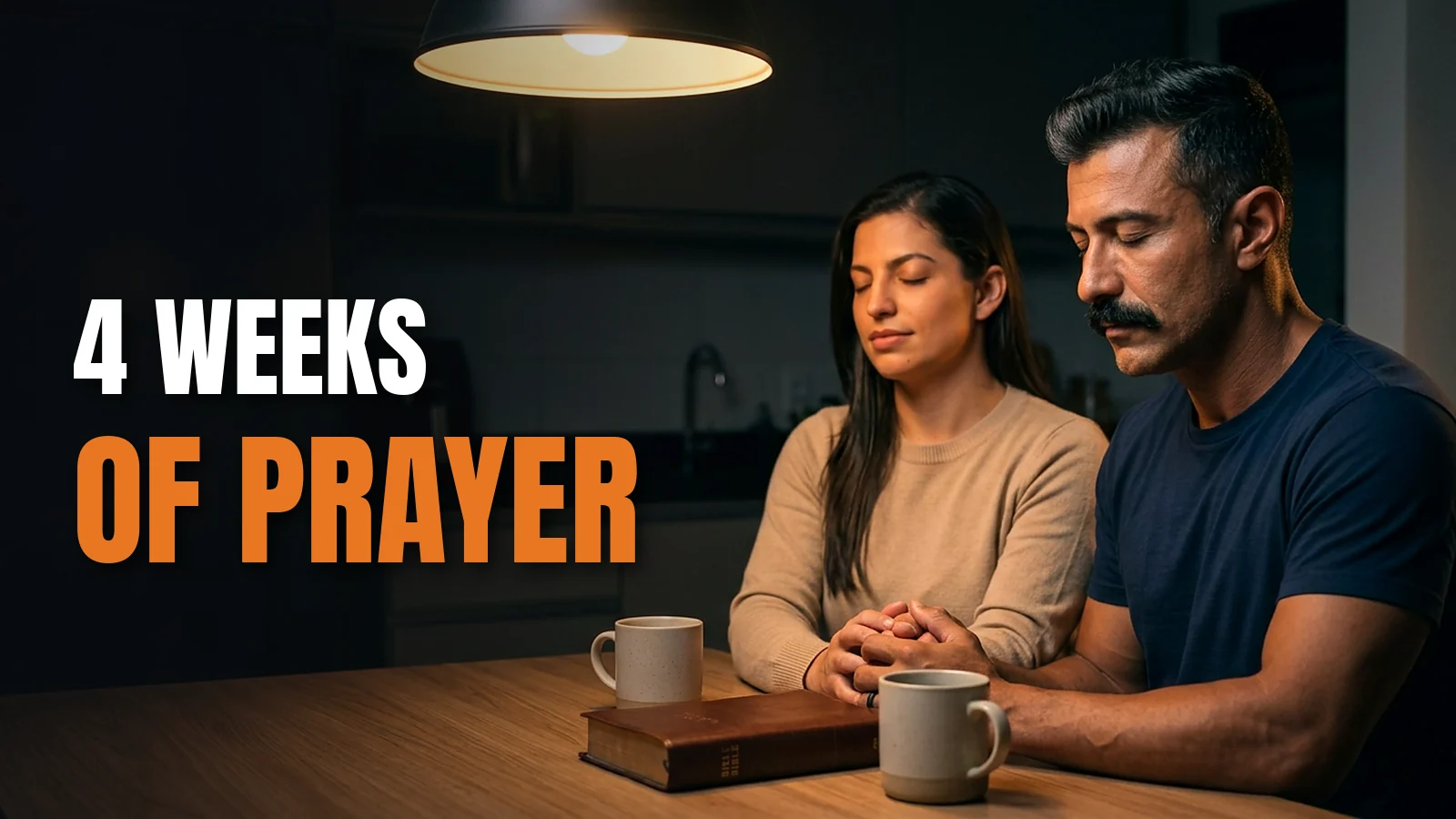
“We know we should pray together, but we just can’t. We start, it gets awkward, and one of us gives up.” Or the more painful version: “I’ve been praying alone for years. He doesn’t even know.”
I hear this from church couples all the time — and it almost always comes with guilt. Everybody has seen the line on a church sign or a coffee mug: “The couple that prays together stays together.” So if we’re not praying together, is our marriage doomed?
I was once the problem in my own marriage. I know what it’s like to sit in a pew with your heart a long way from home. So I don’t want to hand you a slogan. I want to show you what serious studies have actually measured about prayer and marriage — and the surprise in the numbers: the best-documented effect isn’t from praying together. It’s from praying for each other.
What the research found
One honest caveat first: science doesn’t measure God. It measures human behavior — how often people say they pray, how they feel afterward, how their spouse perceives the change. That’s what the numbers below describe. None of them “proves” anything about faith; they show what happens to people who pray.
1. Couples with devotional life at home report better relationships
Christopher Ellison, Amy Burdette, and W. Bradford Wilcox published a study in the Journal of Marriage and Family in 2010 using the National Survey of Religion and Family Life — a 2006 phone survey of 2,400 working-age American adults (ages 18–59), with oversamples of African Americans and Latinos. The core finding: in-home family devotional activities and shared religious beliefs were positively linked with reported relationship quality.
The limit: it’s a snapshot of a single moment. Prayer may help the marriage — or couples who are already doing well may simply find it easier to pray together. The study can’t separate the two. It’s a correlation, not a cause.
2. Praying for a partner reduced unfaithful behavior
This is where the research gets stronger, because it includes experiments. Frank Fincham, Nathaniel Lambert, and Steven Beach (Florida State University and the University of Georgia) published three studies in the Journal of Personality and Social Psychology in 2010, with people in romantic relationships — not necessarily married:
- Study 1 (N = 375): praying for one’s partner predicted less romantic behavior outside the relationship over six weeks, even after accounting for relationship satisfaction and starting levels of that behavior.
- Study 2 (N = 83): participants were assigned to one of three groups. Those assigned to pray for their partner every day for 4 weeks showed less unfaithful behavior than those who simply thought positive thoughts about their partner or did a neutral activity. What explained the difference was seeing the relationship as sacred.
- Study 3 (N = 23): objective outside observers rated participants who had prayed for their partner for 4 weeks as more committed to the relationship than controls.
Notice the detail: “thinking nice thoughts about your partner” did not produce the same effect. Prayer did something positive thinking didn’t.
3. Praying for someone increased willingness to forgive
The same year, Lambert, Fincham, and colleagues published two experiments in Psychological Science. In the first (N = 52), people assigned to pray for their romantic partner reported greater willingness to forgive than those who described their partner to an imagined parent. In the second (N = 67), over 4 weeks, people who prayed specifically for a friend forgave more than those who prayed about anything else or just thought positive thoughts about that friend. The measured mechanism: an increase in selfless concern — the focus moved off yourself and onto the other person’s good.
The limit: small samples, and the second study involved friendship, not marriage.
4. In married couples, each spouse’s prayer shaped both partners’ commitment
The missing piece was a test in real marriages. In 2014, Fincham and Beach published a study in the Journal of Family Psychology with 205 married African American couples. Both spouses’ prayer for their partner was consequential for commitment — including the other spouse’s commitment — partly through better relationship quality. The same paper includes a study of 316 college students in exclusive relationships with a similar result.
5. Your spouse notices when you pray for them
The obvious critique of these studies is that the person praying is also the person filling out the questionnaire. In 2017, Fincham and Ross May addressed that in the Journal of Family Psychology. With 91 married couples, they asked the spouse to rate how forgiving their partner was. Even controlling for religiosity, praying for one’s partner predicted the partner reporting more forgiveness from the one who prayed. In a separate sample of 89 couples, prayer for one’s spouse predicted one’s own forgiveness, even controlling for marital satisfaction.
In other words, the change doesn’t stay in the head of the person praying. The person across the kitchen table feels it.
What these studies do NOT say
- Nearly all samples are American, and several are college students.
- The experiments last weeks, not decades.
- No study shows that praying together “guarantees” a couple won’t divorce.
- Beach and colleagues, in a 2008 paper on prayer in marriage programs, explicitly discuss the potential negative effects of prayer for couples. In my pastoral experience, the most common one is the “sermon prayer”: praying out loud to send your spouse a message.
What this changes in practice
- Start by praying for your spouse — on your own. If praying together still feels awkward, don’t wait for your spouse to sign up. The experiments found effects from daily, individual prayer focused on the partner’s good.
- Try a 4-week test. That’s the length of the experiments. Every day, ask God for good things for your spouse — not changes in them. “Lord, give her peace at work” is very different from “Lord, make him stop being rude.”
- When you pray together, start small. One minute holding hands before bed. One sentence of thanks each. The home devotional life in the Ellison study doesn’t have to be an hour-long family service.
- Never use prayer as a weapon. If you need to say something hard, say it face to face, outside of prayer. Prayer that turns into accusation destroys the very thing it should protect.
- Watch what changes in you. The studies measured forgiveness, commitment, and concern for the other person — in the one who prayed. If after four weeks you’re quicker to forgive, prayer is already doing its work.
Where the Bible already pointed
Jesus was radical: “love your enemies and pray for those who persecute you” (Matthew 5:44, NIV). He didn’t tell us to pray only when we feel affection. He told us to pray precisely for the people who hurt us. The Lambert and Fincham studies show, in lab language, part of the why: it’s hard to keep feeding resentment toward someone you lift up to God every day.
Paul describes the shift researchers called “selfless concern”: “not looking to your own interests but each of you to the interests of the others” (Philippians 2:4, NIV). Praying for your spouse is a daily workout in exactly that.
And on staying with it: “Be joyful in hope, patient in affliction, faithful in prayer” (Romans 12:12, NIV). Four weeks is the length of an experiment. Faithfulness is the length of a marriage.
One caveat, because I take this seriously: prayer is not a technique to fix your spouse, and it isn’t a promise that everything will work out. It’s surrender. If there is abuse, addiction, or danger, prayer goes hand in hand with professional help and your church — never in place of them.
Closing
“The couple that prays together stays together” isn’t a law of physics. But the research points in a direction Scripture already did: when you bring your spouse to God every day, the first person who changes is you. And a heart that forgives more and commits more changes the climate of the whole house.
If you can’t pray together yet, start tonight by praying for each other. Vanessa Lima and I share more about rebuilding a marriage with Christ at the center on our YouTube and Instagram.
Sources
- Ellison, Burdette & Wilcox (2010). The couple that prays together: race and ethnicity, religion, and relationship quality among working-age adults. Journal of Marriage and Family, 72(4), 963–975 — Journal of Marriage and Family (Wiley)
- Fincham, Lambert & Beach (2010). Faith and unfaithfulness: can praying for your partner reduce infidelity? Journal of Personality and Social Psychology, 99(4), 649–659 — Journal of Personality and Social Psychology / PubMed 20718545
- Lambert, Fincham, Stillman, Graham & Beach (2010). Motivating change in relationships: can prayer increase forgiveness? Psychological Science, 21(1), 126–132 — Psychological Science / PubMed 20424033
- Fincham & Beach (2014). I say a little prayer for you: praying for partner increases commitment in romantic relationships. Journal of Family Psychology, 28(5), 587–593 — Journal of Family Psychology / PubMed 24364362
- Fincham & May (2017). Prayer and forgiveness: beyond relationship quality and extension to marriage. Journal of Family Psychology, 31(6), 734–741 — Journal of Family Psychology / PubMed 28504520
- Beach, Fincham, Hurt, McNair & Stanley (2008). Prayer and marital intervention: a conceptual framework. Journal of Social and Clinical Psychology, 27(7), 641–669 — Journal of Social and Clinical Psychology / PubMed 20054450
Ricardo Martins
Ricardo Martins is an author, pastor and spokesperson for the Legendários men's movement. With his wife, Vanessa Lima, he created The Legendary Couple (O Casal Legendário), reaching millions with content on Christian marriage and restoration. Author of "Quando o amor recomeça" (Citadel, 2026).
Want to talk with Ricardo & Vanessa?
Follow the daily videos on YouTube and Instagram — real testimony, practical steps, and hope for marriages that look finished.
Watch on YouTubeKeep reading
How to Forgive When Your Spouse Never Apologizes
What do you do when your spouse never admits they were wrong? Ricardo Martins explains why forgiveness doesn't hinge on an apology, what forgiving does not mean, and how to let go of hurt without pretending nothing happened.
Read article →
Reconciliation After Separation: Practical and Spiritual Steps
Getting back together after a separation isn't hitting a reset button. Ricardo Martins shows, from Scripture and research, the practical and spiritual steps of a reconciliation that doesn't rebuild the same marriage that broke.
Read article →
How to apologize for real (it’s not “sorry if I hurt you”)
“I’m sorry if I hurt you” isn’t an apology — it’s a way to end the conversation. Ricardo Martins shows, from Scripture and research, what separates a real apology from an empty one in marriage.
Read article →This content is educational and pastoral. It does not replace therapy, medical, legal or emergency help. If you are in danger, seek help now.